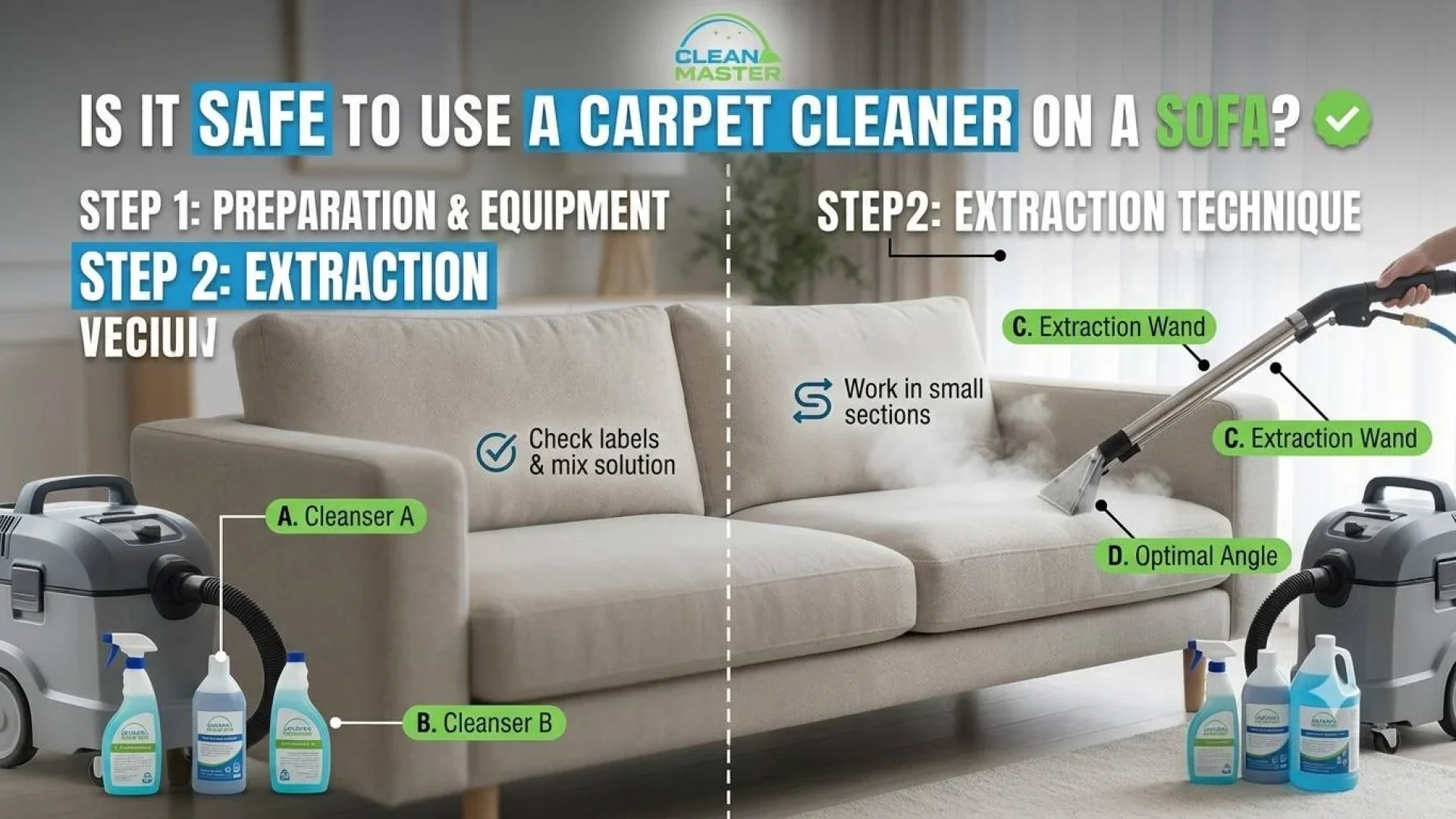
The couch is dirty, the carpet cleaner is in the closet, and it seems like the same basic logic should apply to both. It’s a cleaning machine, upholstery is fabric, how different can it really be?
The answer is: more different than the assumption allows for. At Clean Master Carpet Cleaning, we’ve been called in to assess couches that were cleaned with carpet cleaners and came out worse than they went in, not because the homeowner didn’t try, but because the machine and the fabric were a bad match that nobody warned them about.
Here’s the myth-busting breakdown by couch type, what carpet cleaners do to each material, where the real risks are, and what to do instead.
Why a Couch Isn’t Just Carpet on a Frame
Before getting into individual fabric types, it’s worth addressing the assumption that makes this mistake so common.
Carpet and couch upholstery look similar, both are fabric, both get dirty, both respond to cleaning. But the structural differences between them are significant:
- Carpet has a subfloor beneath it with airflow on all sides, moisture introduced during cleaning has somewhere to go. Couch cushion foam is enclosed on most sides by fabric, with almost no airflow. Moisture that penetrates into the foam stays there.
- Carpet fibers are engineered for heavy, repeated moisture exposure. Upholstery fabrics, particularly delicate ones, are not. They’re designed for durability against sitting and friction, not against the alkaline chemistry and water volume of carpet cleaning solutions.
- Carpet is extracted by a machine. Whatever goes into the carpet largely comes back out during extraction. On a couch, extraction is partial at best, a meaningful volume of water and solution remains in the fabric and foam after the machine has passed over it.
These three differences explain why the same machine that cleans carpet effectively can damage, over-wet, or leave residue on a couch using identical technique.
Couch Type Breakdown: What Carpet Cleaners Actually Do
Fabric and Microfiber Couches
Fabric and microfiber are the most carpet-cleaner-compatible couch materials, which still doesn’t mean the standard carpet cleaning approach works safely. The compatibility depends on checking the care label first.
Every upholstered couch has a care code:
- W means water-based cleaning is safe and carpet cleaner may be appropriate
- S means solvent-based only and no water-based products including carpet cleaner
- W/S means either method is acceptable
- X means vacuum only with no liquid cleaning of any kind
If the couch is labeled S or X, a carpet cleaner is the wrong tool regardless of fabric appearance. For W or W/S-coded fabric couches, carpet cleaner used carefully can work, with these non-negotiable adjustments:
- Dilute the solution significantly, 1 part carpet cleaner to 3 or 4 parts water. Full-concentration carpet cleaning solution is formulated for carpet fiber, not for the lighter fabric weaves used in upholstery.
- Apply to a microfiber cloth, not directly to the couch. Spraying directly introduces more moisture than the fabric and foam beneath can handle safely.
- Blot immediately and thoroughly. Press clean dry towels firmly into the cleaned area after each section to extract as much moisture as possible before it reaches the foam.
- Dry actively. Prop cushions upright, run fans across the surface, and leave the room ventilated until fully dry.
The over-wetting risk is real. We’ve seen fabric couches cleaned with carpet cleaners develop a musty smell within a week, not because the clean failed on the surface, but because moisture that reached the foam didn’t dry fully before the couch was put back in use. Cushion foam that retains moisture in a warm DFW home creates conditions for mold that isn’t visible until it’s well-established.
Residue is the second risk. Carpet cleaning solution not fully extracted from upholstery fabric leaves a slightly tacky film that attracts dust and body oils. Clients who used carpet cleaner on a couch and noticed it seemed to look dirty again faster than before, that’s residue, not the cleaning failing.
Leather Couches
Leather and carpet cleaner are incompatible in the same way leather and laundry detergent are incompatible. The alkaline surfactants in carpet cleaning solutions strip the protective topcoat from leather, dry out the leather beneath, and accelerate cracking at stress points, armrests, seat edges, headrest areas.
The damage pattern we see from DFW clients who’ve used carpet cleaner on leather is consistent:
- Initial appearance: the leather looks cleaner and slightly dull immediately after
- Within days to weeks: the surface develops a flat, slightly chalky appearance where the topcoat has been compromised
- Over months: cracking begins at stress points as the leather loses the moisture and protection the topcoat provided
This damage is cumulative and not fully reversible without professional leather restoration. A single application may not cause dramatic immediate harm, but repeated use of carpet cleaner on leather accelerates deterioration significantly and shortens the functional life of the piece.
What to use instead: a pH-balanced leather cleaner applied with a soft cloth, followed by a leather conditioner. This two-step approach cleans without stripping and restores the moisture the leather needs to stay supple.
Velvet and Delicate Fabric Couches
Velvet, chenille, silk blends, and other delicate upholstery fabrics are the highest-risk category for carpet cleaner use, and the damage typically appears on the first application.
The pile structure of velvet, the raised loops that give it its characteristic texture and sheen, is extremely sensitive to both moisture and mechanical pressure. Carpet cleaning solution introduced to velvet causes the pile to:
- Crush and mat in the direction of application, changing the fabric’s texture permanently
- Develop watermarks, tide lines where the moisture boundary dried that are visible from across the room
- Bleed or shift color, velvet dyes particularly on darker tones can run or become uneven when exposed to the alkaline chemistry of carpet cleaning solutions
Shrinkage is also a risk on natural fiber velvet and some chenille weaves, the fibers contract under moisture exposure and the fabric puckers or pulls at seams.
We’ve seen velvet couches that were visibly and permanently changed after a single carpet cleaner application. There is no cleaning treatment that restores crushed velvet pile or removes set watermarks, the damage is structural to the fabric itself.
What to use instead: velvet and delicate fabrics should only be cleaned by professionals with experience in delicate upholstery. In between professional cleans, a soft-bristle brush used in the direction of the pile removes surface debris without disturbing the structure.
Quick Reference: Carpet Cleaner Compatibility by Couch Type
| Couch Material | Carpet Cleaner Safe? | Primary Risks | Use Instead |
| Fabric and microfiber (W-coded) | Cautiously, with dilution and technique | Over-wetting, residue buildup | Diluted upholstery cleaner, cloth application |
| Fabric and microfiber (S or X coded) | No | Moisture damage, fabric distortion | Solvent-based cleaner or professional |
| Leather | No | Topcoat stripping, drying, cracking | pH-balanced leather cleaner and conditioner |
| Velvet and delicate fabric | No | Pile crushing, watermarks, color bleed | Professional delicate upholstery cleaning only |
The Over-Wetting Problem All Couch Types Share
Regardless of fabric, every couch shares the foam core vulnerability that makes carpet cleaner use higher-risk than most homeowners anticipate.
Couch cushion foam, whether polyurethane, memory foam, or spring-supported, is dense and enclosed. A carpet cleaner introduces more moisture than a deliberately applied cloth-based approach, and extraction from upholstery is always partial. What the machine doesn’t pull back out stays in the fabric and begins migrating into the foam beneath.
In DFW summers where indoor humidity is already elevated, foam that retains moisture after a couch clean has minimal capacity to dry. The result is mold growth inside the cushion, invisible at the surface, detectable first as a musty smell, and by the time it’s visible it’s already significant.
The practical rule: less moisture is always better on upholstery. Apply to a cloth rather than directly. Blot immediately after each section. Dry actively with fans. Don’t use the couch until cushions pass the hand-test, room temperature with no cool dampness when pressed firmly.
When to Call Clean Master Instead
For fabric couches with light to moderate soil, careful DIY cleaning with the right technique and dilution produces reasonable results. For anything else, leather, velvet, delicate fabric, heavily soiled or pet-odor-affected couches, or any situation where you’re uncertain about the fabric code, professional upholstery cleaning is the right call.
At Clean Master Carpet Cleaning, our upholstery cleaning service covers the full range of couch types across the entire DFW area. We check the care label before selecting a method, use chemistry matched to the fabric, and apply extraction technique that cleans without the over-wetting risk that consumer carpet cleaners carry on upholstery.
We also offer combined carpet and upholstery cleaning in a single visit, the most efficient way to get every soft surface in the home addressed at once.
More Carpet Care Guides
Frequently Asked Questions
My couch care label says W/S. Can I use a carpet cleaner on it?
W/S means both water-based and solvent-based methods are acceptable. A carpet cleaner applied carefully, heavily diluted, applied to a cloth rather than directly, blotted immediately, is within the W/S range. That said, a purpose-made upholstery cleaner is still a better choice than carpet cleaning solution because it’s formulated for the lighter application that upholstery requires.
Can carpet cleaner remove pet odor from a fabric couch?
It removes surface-level odor partially, the same limitation it has on pet odor in carpet. For pet urine that has reached the cushion foam, an enzyme cleaner applied carefully and allowed to dwell is the appropriate treatment. Carpet cleaner addresses the fabric surface but doesn’t break down the uric acid crystals responsible for persistent pet odor. For significant pet odor in couch cushions, professional upholstery cleaning with enzyme treatment is the most reliable solution.
How do I know if my couch foam has developed mold after cleaning?
The first sign is a musty smell that develops or intensifies in the days after cleaning, particularly when the room warms up. If the couch smells musty when you sit on it or when the cushions are compressed, moisture is retained in the foam. Remove cushion covers if possible and inspect for visible discoloration or mold spots on the foam surface. If mold is present, professional assessment is the appropriate next step, surface cleaning won’t address growth that has established inside the foam.
The Bottom Line: Fabric Type Determines Everything
A carpet cleaner on a couch isn’t automatically a mistake, but it’s not automatically fine either, and the cases where it’s safe are narrower than most people assume. W-coded fabric couches cleaned with carefully diluted solution and thorough blotting can come out well. Leather, velvet, and S-coded or X-coded fabrics cannot be safely cleaned with carpet cleaning equipment, and the damage when they are is typically significant and not reversible.
Check the care label before any cleaning decision. When the label says no, or when the fabric type is in the damage-risk category, clean furniture deserves a method that’s actually matched to it. Contact Clean Master Carpet Cleaning today for professional upholstery cleaning across the entire DFW area, the right method for every fabric, every time.