
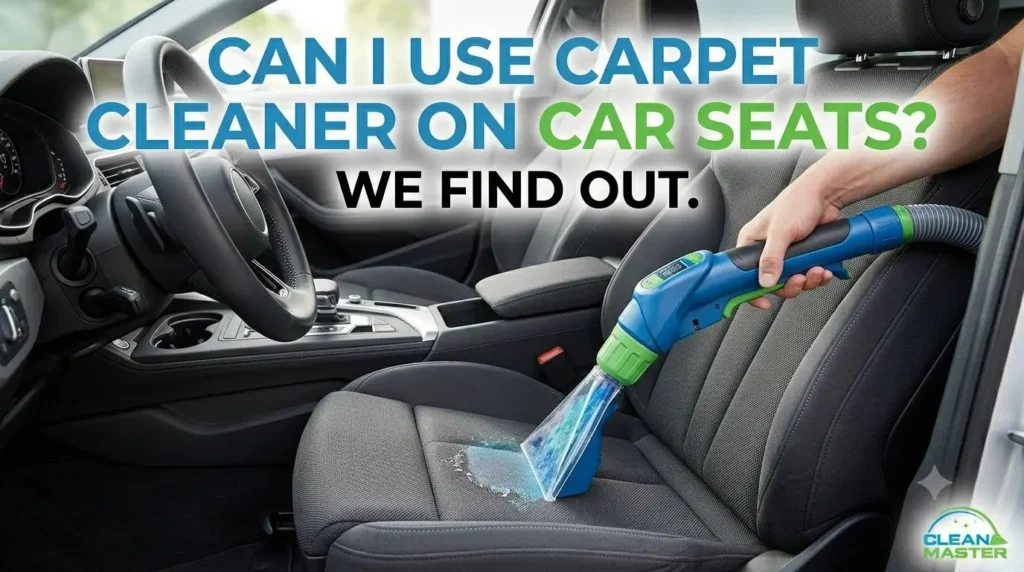
Car seats get dirty. Food spills, muddy kids, pet hair, sweat, the interior of a frequently used vehicle takes real punishment. So when the carpet cleaner is sitting in the garage and the car seats need attention, it seems like a logical shortcut.
The problem is that “carpet cleaner on car seats” isn’t one scenario, it’s several completely different scenarios depending on what your seats are made of. On fabric seats used correctly, the results can be reasonable. On leather and vinyl, carpet cleaner causes damage that’s difficult and expensive to reverse.
At Clean Master Carpet Cleaning, we serve the entire DFW area and our upholstery cleaning work, both residential and vehicle, gives us a clear view of what happens when the wrong product meets the wrong material. Here’s the myth-busting breakdown, seat type by seat type.
Why Carpet Cleaner Isn’t a Universal Upholstery Solution
Before getting into individual seat types, it’s worth understanding why this assumption exists and why it’s flawed.
Carpet cleaning solutions are formulated for synthetic carpet fiber, nylon, polyester, olefin. They’re designed to:
- Penetrate fiber at volume and rinse out during extraction
- Work at an alkaline pH to break down acidic carpet soils
- Produce some foam to lift and suspend debris
- Be used with equipment that extracts moisture back out
Car seat materials, particularly leather and vinyl, have none of the properties that make carpet fiber tolerant of these characteristics. Alkaline surfactants that work well on nylon attack leather finish and vinyl surface coatings. Foam residue that gets extracted from carpet sits in car seat foam indefinitely without a machine to pull it out. Moisture that dries from a carpet in hours is sealed inside a car seat’s dense foam core with very little airflow.
The assumption that “it cleans fabric, seats are fabric” ignores the material and application differences that determine whether a product is safe.
Seat Type Breakdown: What Carpet Cleaner Does to Each Material
Fabric and Cloth Car Seats
Of the three seat types, fabric car seats are the most compatible with carpet cleaning products, which makes sense since the fiber composition of automotive fabric is often similar to residential carpet. Many fabric car seats are woven polyester or nylon blends that respond to carpet cleaner chemistry reasonably well.
That said, reasonably well comes with meaningful caveats:
- Dilute the product significantly. Carpet cleaner at full concentration is stronger than fabric car seats need. A 1:3 or 1:4 dilution with water is more appropriate for automotive fabric than the carpet cleaning concentration on the label.
- Apply to a cloth, not directly to the seat. Spraying carpet cleaner directly onto a car seat introduces more moisture than the foam beneath can handle quickly. Apply to a microfiber cloth and work it into the fabric in sections.
- Extract or blot thoroughly. Car seats don’t have a machine extracting moisture, you do, with dry towels and elbow grease. Press clean dry towels firmly into the treated area immediately after cleaning to pull moisture out before it migrates into the foam below.
- Leave doors open to dry. A sealed car interior is a poor drying environment. Open doors and windows and if possible park in a low-humidity area or run the car’s climate system to circulate air through the cabin.
The risk on fabric seats isn’t damage in the way leather faces it, it’s over-wetting and residue. Both are manageable with the right technique.
Discoloration risk: some automotive fabrics, particularly those with color variation or darker tones, can show subtle lightening or uneven color after carpet cleaner contact. Always test in a hidden area under a seat or on a tucked seam before treating visible surfaces.
Leather Car Seats
This is where the myth causes the most expensive damage, and where we’ve seen the clearest pattern in our DFW upholstery work. Leather car seats and carpet cleaner are genuinely incompatible, and the damage isn’t always immediate, which is part of what makes it so frustrating.
Here’s what happens when carpet cleaner contacts leather:
Surfactants strip the protective finish. Leather car seats have a topcoat, a polyurethane or acrylic finish that protects the leather beneath, gives it sheen, and provides resistance to staining and cracking. Carpet cleaning surfactants break down surface bonds by design. On leather, they attack the topcoat finish, gradually stripping it away. The leather beneath, now less protected, is exposed to accelerated drying, cracking, and staining.
Alkaline pH dries out the leather. Leather has a natural pH slightly on the acidic side, and it requires moisture and conditioning to stay supple. Alkaline carpet cleaner solution disrupts this balance, drawing moisture out of the leather and leaving it dry and prone to cracking. Repeated exposure accelerates this significantly.
The damage is cumulative and visible. A single carpet cleaner application on leather may not cause dramatic immediate damage. Over multiple applications, the finish dulls, the leather surface develops a chalky or flat appearance, and cracking begins at stress points, seat edges, headrest folds, seat bolsters. By the time it’s clearly visible, the topcoat is already compromised.
We’ve had clients bring upholstery cleaning jobs to our attention where leather that should have had years of life left was cracked and dull from repeated cleaning with inappropriate products, carpet cleaner among them. Leather conditioning and professional treatment can slow further deterioration, but the topcoat damage isn’t reversible without professional leather restoration.
What to use on leather instead: a dedicated leather cleaner, pH-balanced and formulated specifically for automotive leather, followed by a leather conditioner. Products from brands like Lexol, Chemical Guys Leather Cleaner, or manufacturer-recommended options are appropriate. Leather cleaning is a two-step process: clean, then condition. Carpet cleaner does neither correctly.
Vinyl and Faux Leather Seats
Vinyl and faux leather are common in mid-range vehicles and in rear seats across many vehicle categories. They look similar to leather and are often assumed to be more durable, which is true in some respects, but not when it comes to carpet cleaner exposure.
The surface coating on vinyl and faux leather seats is thinner and less resilient than genuine leather topcoat. Carpet cleaner surfactants strip this coating faster, and the damage appears sooner. Common outcomes include:
- Surface tackiness or stickiness after cleaning that attracts more dirt
- Discoloration, particularly on lighter-colored vinyl, which can develop yellowish or uneven tones
- Peeling or flaking of the surface coating in areas of regular contact such as seat bolsters and headrests
- A dull, flat finish where the original sheen has been stripped
Vinyl is also less able to recover from alkaline chemical exposure than genuine leather. Once the surface coating is compromised, the underlying material is porous and difficult to protect without professional surface restoration.
What to use on vinyl and faux leather instead: a mild, pH-neutral interior cleaner designed for vinyl surfaces, applied sparingly with a microfiber cloth and wiped dry immediately. Avoid soaking the surface and follow up with a vinyl protectant to restore surface resistance after cleaning.
Quick Reference: Carpet Cleaner Compatibility by Seat Type
| Seat Material | Carpet Cleaner Safe? | Primary Risk | Use Instead |
| Fabric and cloth | Cautiously, with dilution | Over-wetting, residue, possible discoloration | Diluted upholstery cleaner or dedicated fabric cleaner |
| Genuine leather | No | Finish stripping, drying, cracking | pH-balanced leather cleaner and conditioner |
| Vinyl and faux leather | No | Surface coating damage, discoloration, peeling | pH-neutral vinyl cleaner and protectant |
The Over-Wetting Problem All Seat Types Share
Regardless of material, every car seat shares one vulnerability that makes carpet cleaner particularly risky compared to purpose-made interior cleaners: the foam core.
Car seat foam is dense, enclosed on most sides by the seat material, and has very limited airflow. Moisture that penetrates past the surface fabric or material into the foam beneath has almost nowhere to go. In a house, a damp sofa cushion can be stood upright, placed near a fan, or removed from its cover. In a car, the seat foam sits in an enclosed cabin with limited ventilation.
Foam that retains moisture for extended periods, particularly in warm DFW conditions, creates ideal conditions for mold and mildew growth inside the seat. This isn’t visible from the outside until it’s well-established, and by then it affects both air quality in the vehicle and the structural integrity of the foam. Mold remediation inside car seat foam is a specialty job that costs significantly more than the original clean was worth.
Minimizing moisture introduction, through careful dilution, cloth application rather than direct spraying, and thorough blotting after treatment, reduces this risk substantially regardless of which product you’re using.
When to Call a Professional for Car Seat Cleaning
Some car seat cleaning situations are genuinely beyond what DIY treatment can safely resolve:
- Leather seats that need deep cleaning and conditioning, where professional leather treatment restores and protects in ways DIY products can’t match
- Persistent odor in fabric seats, which often indicates contamination in the foam that surface cleaning doesn’t reach
- Mold or mildew in seat foam, which requires professional extraction and antimicrobial treatment
- High-value vehicle interiors, where the cost of a professional clean is trivially small relative to the cost of damage from the wrong DIY product
At Clean Master Carpet Cleaning, our upholstery cleaning service covers both residential furniture and vehicle interiors across the entire DFW area. We match the cleaning approach to the material, which is the only way to clean effectively without risking the surface you’re trying to restore.
Frequently Asked Questions
Can I use diluted carpet cleaner on cloth car seats in an emergency?
Yes, a heavily diluted carpet cleaner solution of 1 part cleaner to 3 or 4 parts water, applied sparingly to a cloth and blotted rather than sprayed, can work for a quick spot clean on fabric seats. Test in a hidden area first, blot thoroughly afterward, and leave doors open to dry. It’s not ideal, but for fabric seats specifically it’s not the risk it is on leather or vinyl.
My car seats are labeled “leatherette.” Is that leather or vinyl?
Leatherette is a marketing term for synthetic leather, typically polyurethane vinyl. Treat it the same as vinyl: no carpet cleaner, pH-neutral vinyl cleaner only.
How long should I leave car doors open after cleaning fabric seats?
At minimum two to three hours in low-humidity conditions. In DFW summer humidity, longer, four to five hours minimum with the climate system running to help circulate air. The goal is to get as much airflow through the cabin as possible to dry the foam beneath the fabric before the car is closed up again.
The Bottom Line: Material Determines Everything
Carpet cleaner on car seats isn’t automatically a disaster, but it’s also not automatically fine. Fabric seats can tolerate a careful, diluted application with proper blotting and drying. Leather and vinyl cannot, and the damage from treating them like carpet is real, cumulative, and expensive to correct.
The safer approach in every case is a product formulated for the specific material you’re cleaning. For fabric, that’s a dedicated upholstery cleaner. For leather and vinyl, that’s a pH-matched interior cleaner designed for that surface. The right product costs the same or less than carpet cleaner and produces better results without the risk.
When the car interior needs professional attention, whether it’s leather conditioning, fabric extraction, or odor treatment, contact Clean Master Carpet Cleaning for upholstery cleaning services across the entire DFW area.