Area rugs are one of those items where the “it’s just fabric, the carpet cleaner should work” logic seems reasonable, and sometimes it is. For the right rug type, a carpet cleaner produces a genuinely good result. For the wrong one, it causes damage that’s expensive or impossible to reverse.
At Clean Master Carpet Cleaning, we’ve cleaned area rugs across DFW homes and we’ve been called in to assess rugs that were damaged by carpet cleaners that weren’t appropriate for the material. The outcome is almost entirely determined by what the rug is made of, not how carefully the machine is operated.
Here’s the rug-by-rug breakdown.
Synthetic Area Rugs: Generally Safe With the Right Technique
Synthetic area rugs, woven or tufted from polyester, nylon, or olefin, are the most carpet-cleaner-compatible rug type. The fiber chemistry is similar to residential carpet, the colors are typically solution-dyed or fiber-dyed with good colorfast stability, and the construction handles moisture reasonably well.
For synthetic area rugs, a carpet cleaner works when these conditions are met:
- Test colorfastness first, press a damp white cloth firmly onto an inconspicuous corner and check for color transfer. If color moves to the cloth, the dye isn’t stable and the rug shouldn’t be machine-cleaned without professional assessment
- Elevate the rug during cleaning, place the rug on a clean tarp, plastic sheeting, or an elevated surface so water can escape downward rather than pooling beneath the rug backing. Cleaning a rug flat on a hard floor traps water between the rug and the surface, saturating the backing
- Use less solution than you would on carpet, area rug pile is often lower-density than residential carpet, requiring less product to clean effectively
- Extract thoroughly and dry actively, run the machine in extraction-only mode across the entire rug after cleaning, then hang or prop the rug upright with fans running to dry both sides
The backing is the vulnerability on even synthetic rugs. Latex-backed area rugs, the most common construction, can delaminate if the backing gets too wet too often. The glue bond that holds the tufted fibers to the backing weakens with repeated moisture exposure. One careful clean typically doesn’t cause issues; repeated over-wetting progressively damages the backing until fibers begin to release.
Wool and Natural Fiber Rugs: Proceed With Serious Caution
Wool and natural fiber rugs require a fundamentally different approach than synthetic rugs, and a standard carpet cleaner is almost never the right tool for them.
Shrinkage is the primary risk. Wool fibers are covered in microscopic scales that interlock when exposed to heat and agitation, the same process that causes a wool sweater to shrink in the wash. Hot water extraction on a wool rug can cause the fibers to felt and shrink, permanently distorting the rug’s dimensions and pile texture. This can be visible as overall size reduction, pile distortion in cleaned sections, or irregular surface texture that doesn’t resolve as the rug dries.
Color bleeding is the second risk. Many wool rugs, particularly hand-dyed or traditionally colored rugs, use natural or reactive dyes that aren’t fully stable under moisture and cleaning chemistry exposure. Water alone can cause dye migration; carpet cleaning solution accelerates it. Bleeding typically shows as color transfer from darker areas into adjacent lighter ones, creating permanent staining that wasn’t there before the clean.
If you have a wool rug and want to clean it at home, spot-cleaning with cold water and a pH-neutral, wool-safe cleaner applied to a cloth is the appropriate approach. For a full clean, professional rug cleaning using cold water methods and wool-appropriate chemistry is the right call.
Hand-Knotted, Persian, and Oriental Rugs: Do Not Use a Carpet Cleaner
This is the category where carpet cleaner use causes the most significant and most expensive damage, and where we’ve seen the clearest pattern of irreversible outcomes from DFW clients who tried it.
Hand-knotted rugs are constructed differently from machine-made rugs. Each knot is individually tied to the warp and weft foundation during manufacture, creating a structure that is both intricate and sensitive to the mechanical pressure and sustained moisture of carpet cleaning equipment.
The risks on hand-knotted rugs are compounding:
- Natural dyes bleed readily, the vegetable and mineral dyes used in traditional Persian and Oriental rugs have varying colorfastness that professional rug cleaners account for with specific pre-treatment. Carpet cleaners don’t provide this, and dye bleeding on a hand-knotted rug can permanently alter its appearance
- Foundation damage from moisture, the cotton or wool warp and weft foundation of hand-knotted rugs can weaken when repeatedly saturated, affecting the structural integrity of the knots and the rug’s dimensional stability
- Pile distortion from machine pressure, the rotating brush or mechanical agitation of some carpet cleaner heads can snag and distort individual knots, causing pile irregularity that’s visible and not correctable
- Backing delamination, many older hand-knotted rugs have been repaired or reinforced with backing materials that react poorly to moisture exposure
Hand-knotted rugs, regardless of age, origin, or apparent condition, should be cleaned professionally by a specialist in rug cleaning. The cleaning method, chemistry, and drying approach all need to be matched to the specific rug construction and dye type. A carpet cleaner, used however carefully, cannot replicate that level of assessment and control.
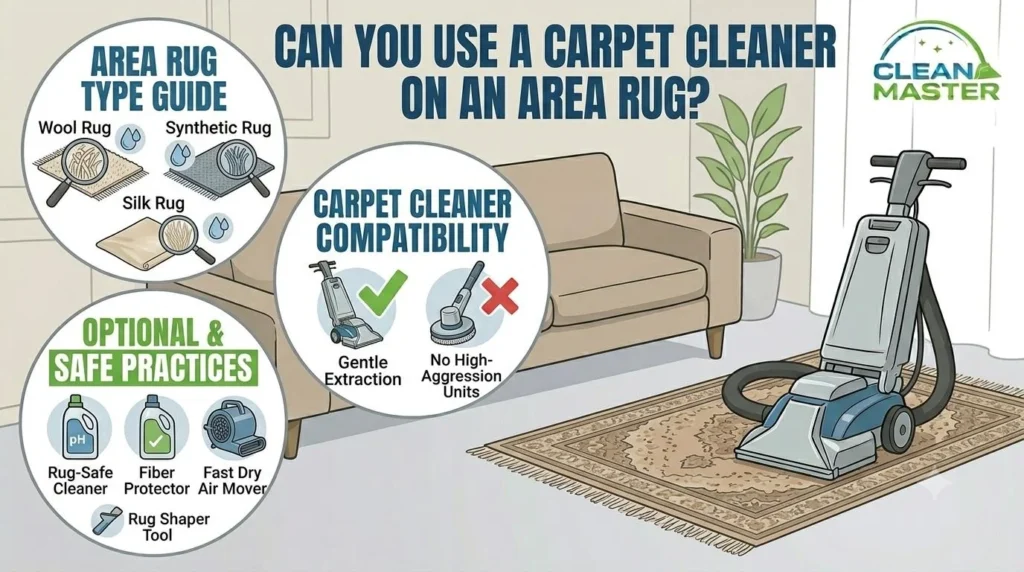
At a Glance: Carpet Cleaner Safety by Rug Type
| Rug Type | Carpet Cleaner Safe? | Primary Risk | Recommended Approach |
| Synthetic (polyester, nylon, olefin) | With proper technique | Backing delamination from over-wetting | Elevate rug, test colorfastness, extract thoroughly |
| Wool | High risk | Shrinkage, color bleeding | Spot-clean only; professional for full clean |
| Natural fiber (cotton, silk) | High risk | Color bleeding, fiber distortion | Professional cleaning recommended |
| Hand-knotted (Persian, Oriental) | No | Dye bleeding, foundation damage, pile distortion | Specialist rug cleaning only |
The Over-Wetting Problem All Rug Types Share
Regardless of rug material, every area rug shares one vulnerability that carpet floor cleaning doesn’t: the backing.
When you clean carpet installed on a floor, moisture that penetrates the fiber has the subfloor beneath it, and extraction pulls the majority back up through the fiber. When you clean an area rug flat on a hard surface, moisture that penetrates through the fiber reaches the backing and pools beneath it with nowhere to go.
Trapped moisture in rug backing creates mold and mildew conditions faster than almost any other home textile scenario, the backing is in contact with a flat, non-porous surface that prevents drying from below, and the top of the rug dries first, sealing the moisture inside. A rug that smells fine when you clean it can develop a musty smell within 48 hours if backing moisture wasn’t fully managed. Read our guide on whether carpet cleaning can cause mold to understand how quickly trapped moisture becomes a serious problem.
The non-negotiable technique for any rug cleaned with a carpet cleaner: elevate the rug during and after cleaning so water can escape beneath it, and dry both sides actively with fans until the rug is completely dry through its full thickness, not just at the surface.
Frequently Asked Questions
Can I clean a machine-made wool-blend rug with a carpet cleaner?
Wool-blend rugs, typically 20 to 30% wool with synthetic fiber, are more tolerant than pure wool but still carry shrinkage and color risk. Test colorfastness in a hidden corner first, use cold water rather than hot, and use a wool-safe cleaning solution rather than standard carpet cleaner. Extract thoroughly and dry flat with good airflow. If the rug has significant value or sentimental importance, professional cleaning is still the safer choice.
My area rug has rubber backing. Does that change anything?
Rubber-backed rugs are particularly vulnerable to backing damage from repeated moisture exposure. Rubber backing can crack, crumble, or delaminate when repeatedly saturated and dried, which transfers black rubber residue to the floor beneath the rug and leaves the rug backing structurally compromised. For rubber-backed rugs, keep moisture exposure minimal and dry thoroughly after any cleaning.
How do I know if my rug is hand-knotted or machine-made?
Turn the rug over and examine the back. Hand-knotted rugs show the individual knot pattern on the reverse, the back mirrors the design with visible knot nodes. Machine-made rugs have a uniform, even backing that doesn’t show individual knots. If the back looks woven in a regular, machine-consistent pattern with a separate backing material, it’s machine-made. If you can see individual knots that correspond to the pile pattern, it’s hand-knotted.
The Bottom Line: Know Your Rug Before the Machine Touches It
A carpet cleaner on a synthetic area rug, used with the right technique, produces good results. On wool, it’s high risk. On hand-knotted rugs, it’s a mistake with potentially permanent and expensive consequences.
The two minutes spent checking what the rug is made of, and whether it’s appropriate for machine cleaning, is the most important step in the whole process. For anything in the caution or no-go category, Clean Master’s professional upholstery and rug cleaning service handles the assessment and the clean correctly across the entire DFW area. Contact Clean Master Carpet Cleaning today for professional rug and upholstery cleaning in DFW and the right method for every material.