

If you’ve already read our post on using an upholstery cleaner on a mattress, you know the answer there is a cautious yes, with strict technique, minimal moisture, and careful drying. A carpet cleaner is a different conversation entirely.
Where an upholstery cleaner applied carefully introduces controlled, limited moisture, a carpet cleaner is engineered to do the opposite: inject significant volumes of water and solution deep into a surface and extract it back out. That process works brilliantly on carpet. On a mattress, it’s a setup for damage that unfolds slowly, invisibly, and expensively.
We’re not saying it’s physically impossible to run a carpet cleaner over a mattress. We’re saying that in most cases, the aftermath isn’t worth it, and we’ve had DFW clients call us to deal with exactly that aftermath.
What a Carpet Cleaner Actually Does to a Mattress
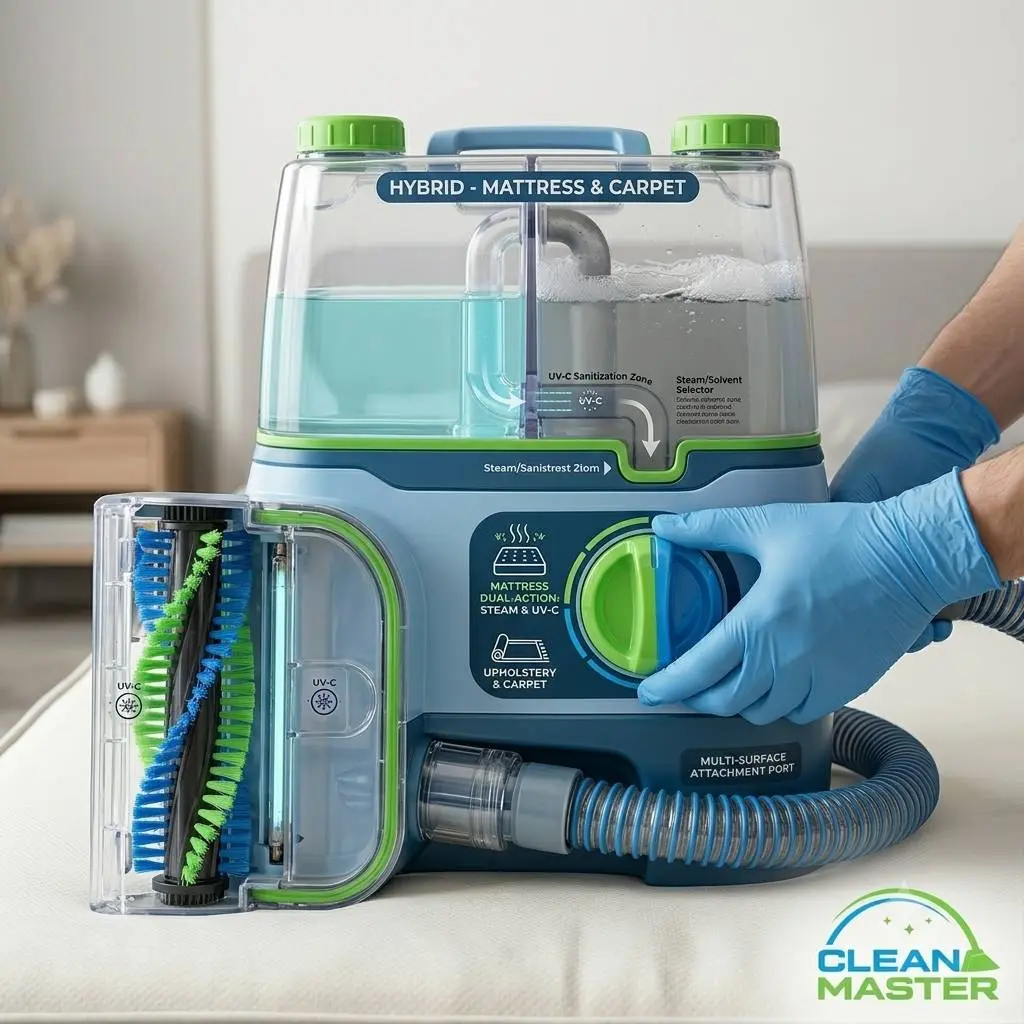
To understand why this combination is problematic, it helps to understand what a carpet cleaner is designed to do. Hot water extraction, the method used by both consumer and professional carpet cleaning machines, works by forcing heated water and cleaning solution into the surface material under pressure, then immediately extracting it along with the loosened dirt.
Carpet handles this process because it’s engineered for it. The fibers are synthetic and moisture-resistant, the backing dries relatively quickly, and the subfloor beneath allows airflow from below. A mattress has none of these properties.
When a carpet cleaner is used on a mattress, the water and solution don’t just clean the surface fabric, they penetrate into the layers beneath. Memory foam, latex, and the batting layers inside hybrid and innerspring mattresses are highly absorbent materials with almost no capacity to release moisture quickly. The extraction pass pulls back what it can from the surface, but a significant volume of water remains trapped inside the mattress where no fan or dehumidifier can reach it. That trapped moisture is where the problems begin.
The Risks and Why They’re Worse Than You’d Expect
Mold and Mildew Deep Inside the Mattress
This is the outcome we see most often in the aftermath calls we receive, and it’s the hardest to fix. Mold established inside a mattress, in the foam core, the batting layers, or the border material, is not accessible from the surface. You can’t treat it with a spray. You can’t extract it with a machine. By the time it’s detectable as a smell, it’s already throughout the interior of the mattress.
We’ve had clients in the DFW area contact us weeks after attempting a carpet cleaner clean on their mattress, convinced their bedroom had a mold problem somewhere in the walls or HVAC system. The source was the mattress, specifically the moisture that had been sealed inside it since the cleaning. In more than one case, the mattress was unsalvageable.
The timeline is what catches people off guard. The mattress surface dries within a day or two, everything seems fine, and the mold develops quietly over the following weeks in layers the surface temperature never reflects. By the time it’s noticeable, replacement is often the only option.
Structural Damage to Foam and Latex Layers
Carpet cleaning solutions are formulated for synthetic carpet fibers, not for the foam and latex materials inside mattresses. The surfactants, enzymes, and chemical compounds in these solutions interact with foam and latex in ways they don’t interact with nylon or polyester carpet.
Memory foam exposed to carpet cleaning solution can break down at a cellular level, losing the resilience and pressure-relief properties that make it functional. The foam may feel normal initially but gradually develops soft spots, loses its ability to return to shape after compression, or begins to crumble at a microscopic level that eventually becomes visible as surface degradation.
Latex is similarly vulnerable. Natural latex in particular reacts poorly to the alkaline pH of most carpet cleaning solutions, which can cause the material to stiffen, crack, or degrade unevenly over time. This isn’t always immediately obvious, it can take weeks or months to manifest as noticeable changes in how the mattress feels to sleep on.
Chemical Residue on Your Sleeping Surface
Carpet cleaning solution residue left in mattress fabric is a different category of concern than residue left on a carpet. You walk across carpet occasionally. You spend 7 to 8 hours with your face and body in direct contact with a mattress every night.
Carpet cleaning solutions contain surfactants, fragrances, optical brighteners, and pH-adjusting compounds that are appropriate for floor surfaces you contact intermittently. None of these were designed for prolonged skin contact or inhalation at close range during sleep. Residue that remains in mattress fabric after a carpet cleaner treatment, and some always does, is in contact with your airways and skin throughout every night until the mattress is either professionally cleaned to remove it or replaced.
For households with children, people with skin sensitivities, or anyone with respiratory conditions, this risk is particularly significant. Read our guide on getting rid of carpet cleaner residue to understand how persistent solution residue can be even on surfaces with better drainage than a mattress.
What Our Clients Learned the Hard Way
The calls we receive in the aftermath of carpet cleaner mattress cleaning tend to follow a similar pattern. The client cleaned the mattress, it looked and smelled noticeably better immediately afterward, and they considered it a success. Then, somewhere between two weeks and two months later, a musty smell appeared in the bedroom that they couldn’t locate or eliminate.
In one case, a client had already replaced their HVAC filters, cleaned their air vents, and checked behind furniture for mold before calling us. The mattress hadn’t crossed their mind as the source, it had seemed fine after the clean. When we inspected it, the interior foam layers were visibly discolored with mold growth that had been developing since the cleaning.
In another case, a client noticed their memory foam mattress had developed an uneven sleeping surface, a soft depression on one side that hadn’t been there before the clean. The foam in that area had been compromised by the cleaning solution and had lost its structural integrity. The mattress was two years old.
Neither outcome was what the client intended. Both were entirely predictable given what a carpet cleaner does to mattress materials.
What to Do Instead
For Surface Stains: Spot-Clean with an Enzyme Cleaner
For the stains that most commonly prompt mattress cleaning, urine, sweat, blood, an enzyme cleaner applied sparingly to a cloth and blotted onto the stain is both more effective and dramatically safer than a carpet cleaner. Enzyme cleaners break down organic compounds at the source, eliminating stain and odor rather than diluting and redistributing them. Apply to a cloth, blot the stain, extract with dry towels, dry actively with a fan.
For General Odor: Baking Soda
Strip the mattress, apply an even layer of baking soda across the surface, leave it for several hours, vacuum thoroughly. No moisture, no residue, no risk. This is the maintenance method we recommend to virtually every client asking about mattress freshening between professional cleans. For a full walkthrough, see our guide on how to clean your mattress.
For Deep Cleaning: Professional Mattress Cleaning
When the mattress genuinely needs more than spot treatment, after illness, significant staining, or extended time without professional attention, low-moisture professional mattress cleaning is the right tool. Professional mattress cleaning uses methods specifically appropriate for mattress materials, with controlled moisture application and extraction that removes contaminants without saturating the interior layers.
This is the approach that gets the result most people are hoping to achieve with a carpet cleaner, without the mold risk, the material damage, or the residue concern.
Frequently Asked Questions
What if I only use the carpet cleaner on a low moisture setting?
Even on the lowest setting, a carpet cleaner introduces more moisture than a mattress can safely handle without risk of interior dampness. The extraction pass helps, but it cannot remove all the moisture that penetrates below the surface fabric, particularly on foam and latex mattresses. The safer approach is always a cloth-applied, manually controlled method rather than a machine.
My mattress already smells musty after I used a carpet cleaner. What should I do?
Don’t put bedding back on it and don’t sleep on it until it’s been assessed. A musty smell after cleaning is a strong indicator of mold developing inside the mattress. Contact a professional cleaning service for an inspection, in some cases the mold can be addressed with professional treatment, but in others the mattress will need to be replaced. The longer you wait, the more established the mold becomes.
Can I use a carpet cleaner on a mattress protector?
A mattress protector, the kind designed to be removed and laundered, is a different question. Check the care label: if it’s machine washable, launder it rather than using a carpet cleaner on it. If it’s a fitted, non-removable style, treat it as you would the mattress surface itself and keep moisture minimal.
The Bottom Line: The Risk Isn’t Worth It
A carpet cleaner on a mattress is technically possible in the same way that using a pressure washer on a laptop is technically possible. The machine works. The surface gets wet. What happens next is the problem.
Mold you can’t see developing inside foam layers, structural damage to materials that affect how your mattress feels for years, and chemical residue on the surface you sleep on every night, none of these outcomes are hypothetical. They’re what we’ve been called in to address after clients tried this approach and found out the hard way.
For mattress cleaning, the right tools are an enzyme cleaner for stains, baking soda for odors, and professional mattress cleaning for anything beyond that. Save the carpet cleaner for the carpet. Contact our DFW cleaning team today for professional mattress cleaning that’s safe, effective, and done right the first time.