
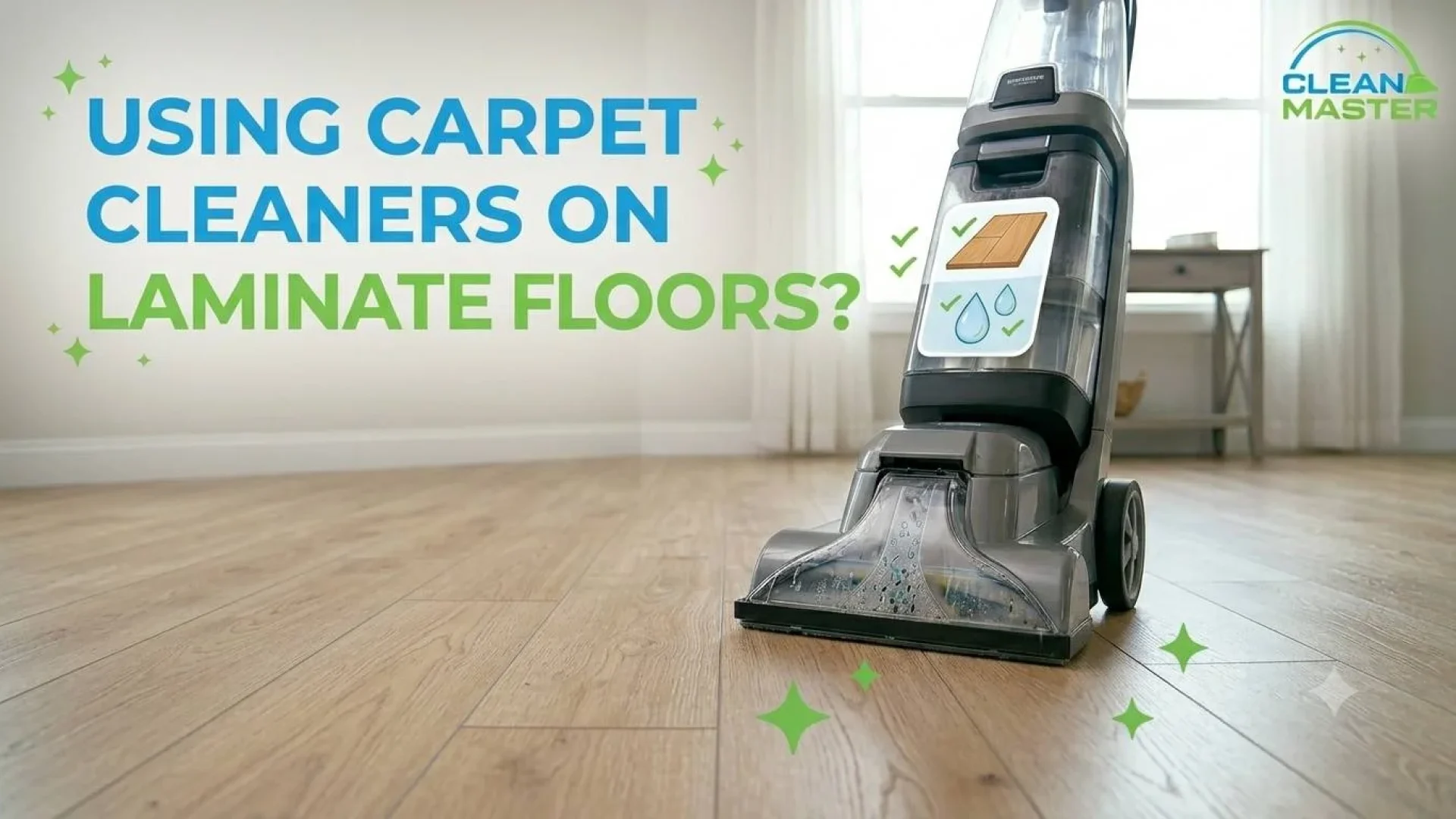
Laminate flooring looks durable. It handles foot traffic, resists surface scratches, and in a lot of homes it looks nearly identical to hardwood. That apparent toughness is what leads homeowners to assume it can handle a carpet cleaner pass, a reasonable-seeming shortcut when the machine is already out and the floor needs attention.
It can’t. At Clean Master Carpet Cleaning, we serve the entire DFW area and we’ve seen the result of carpet cleaners on laminate in multiple forms, swollen seams, bubbling surfaces, and plank damage that required full section replacement. The surface toughness of laminate is real. Its moisture tolerance is not. Here’s the complete picture.
Why Laminate Is Uniquely Vulnerable to Moisture
To understand why a carpet cleaner is so damaging to laminate, you need to understand what laminate actually is beneath the surface.
Laminate flooring is a layered composite product:
- Wear layer, a clear, hard aluminum oxide coating that provides scratch and stain resistance
- Decorative layer, a photographic image of wood, stone, or tile printed onto paper
- Core layer, high-density fiberboard (HDF), the structural layer that gives laminate its rigidity
- Backing layer, a moisture-resistant backing that protects the core from below
The HDF core is the critical vulnerability. High-density fiberboard is made from compressed wood fibers bonded with resin, and despite the compression, it remains essentially wood-based material that absorbs moisture readily when exposed to it. When moisture reaches the HDF core, the fibers expand, causing the visible swelling, bubbling, and seam separation that characterizes laminate water damage.
The wear layer and decorative layer protect the core from brief, surface-level moisture exposure, a spill wiped up promptly, a damp mop used quickly. What they cannot do is protect the core from sustained water exposure or moisture introduced at the seam lines between planks, where the core is directly exposed at the click-lock joint.
A carpet cleaner introduces water in volumes far beyond what laminate’s surface protection can handle, and it introduces it in a sustained, pressurized way that drives moisture directly into seam lines throughout every pass.
The Risks in Detail
Swelling and Bubbling From Moisture Infiltration at Seams
This is the most common and most visible damage outcome, and it begins at the seam lines between planks, not at the surface.
When a carpet cleaner sprays solution across a laminate floor, the water doesn’t just sit on the wear layer. It immediately flows to the lowest point, the seam lines between planks, where it contacts the raw HDF core at the click-lock joint. The core absorbs that moisture within minutes. As the HDF swells:
- Plank edges push upward, creating raised seam lines visible and felt underfoot
- The decorative layer buckles, appearing as bubbling or rippling in the surface that’s visible from any angle
- Click-lock joints separate or deform, in severe cases planks physically separate from their connections and gaps appear between them
This damage is rapid. We’ve seen DFW clients with visible seam swelling within hours of a carpet cleaner pass on laminate. And critically, it’s irreversible. Swollen HDF doesn’t return to its original dimension once dried. The only resolution is replacement of the affected planks.
Surface Finish Damage From Alkaline Carpet Cleaner Chemistry
Laminate’s wear layer is chemically resistant to most household cleaners, but carpet cleaning solutions are formulated at an alkaline pH specifically to break down the acidic compounds in carpet soils. That alkaline chemistry isn’t neutral on laminate’s wear layer.
Repeated exposure to alkaline carpet cleaning solution dulls the wear layer’s reflectivity, creates a hazy or cloudy appearance on the surface, and in some cases causes the decorative layer beneath the wear layer to shift color slightly, affecting the visual warmth of the floor. On laminate with a high-gloss finish, this dullness is particularly obvious.
The surface chemistry damage compounds with the moisture damage, both happen simultaneously when a carpet cleaner is used on laminate.
Irreversible Core Damage Requiring Full Plank Replacement
The HDF core that gives laminate its structural integrity is the same material that makes moisture damage permanent. Unlike solid hardwood, which can sometimes be sanded and refinished after moisture damage, laminate has no recovery option. The decorative layer is a photograph, not real wood, and the compressed fiber core doesn’t return to its pre-swollen state.
Damaged laminate planks must be replaced. In homes where the laminate runs continuously across multiple rooms, a common installation approach that creates a seamless look, replacing a section in one area may require pulling up significantly more floor to reach and replace the damaged planks, depending on the installation direction and how far moisture has traveled beneath adjacent planks.
We’ve worked with DFW clients who used a carpet cleaner on laminate in a single room and ended up needing multiple adjacent sections replaced because moisture had traveled under the floor further than the visible surface damage suggested.
Voiding Manufacturer Warranty
Every major laminate flooring manufacturer, Pergo, Shaw, Armstrong, Mohawk, Quick-Step, and others, explicitly excludes water damage from warranty coverage when it results from inappropriate cleaning methods. Using a carpet cleaner on laminate falls squarely into this exclusion.
Manufacturer warranties for laminate typically cover defects in the product, not damage caused by cleaning methods that contradict their care guidelines. Those guidelines uniformly specify minimal moisture, manufacturer-approved cleaners, and avoidance of steam mops and wet cleaning equipment. A carpet cleaner used on laminate doesn’t just risk the floor, it eliminates the warranty protection that covers it.
At a Glance: What Carpet Cleaners Do to Laminate
| Risk | Cause | Reversible? |
| Seam swelling and bubbling | Moisture infiltration at click-lock joints | No, plank replacement required |
| Surface finish dullness | Alkaline chemistry on wear layer | Partially, professional buffing may help minor cases |
| Core HDF damage | Water absorption causing fiber expansion | No, permanent structural change |
| Warranty void | Use of non-approved cleaning method | No, warranty exclusion applies retroactively |
What to Use on Laminate Instead
Dry Microfiber Mop for Daily Maintenance
This is the laminate-safe daily cleaning standard, and the one every laminate manufacturer recommends as the primary maintenance tool. A dry or barely-dry microfiber mop picks up dust, pet hair, and surface debris without introducing any moisture to the floor.
For laminate specifically, dry mopping is more than just habit, it’s the cleaning approach that keeps moisture exposure at absolute minimum over the long term. The less moisture laminate encounters cumulatively, the longer the core maintains its structural integrity and the longer the floor looks and performs the way it should.
Microfiber attracts and holds debris electrostatically, it doesn’t push it around the way a traditional broom or dust mop does. For daily laminate maintenance, a quality microfiber flat mop is the tool worth investing in.
Barely-Damp Mop With Laminate-Safe Cleaner
For periodic deeper cleaning beyond dry mopping, a barely-damp microfiber mop with a laminate-safe, pH-neutral cleaner is the appropriate approach. The key words are barely-damp, wrung out to the point where no moisture drips from the pad and the floor dries within minutes of each pass.
Laminate-safe cleaners include:
- Manufacturer-recommended products such as Pergo Floor Cleaner and Bona for Laminate
- pH-neutral multi-surface hard floor cleaners explicitly labeled safe for laminate
- Diluted white vinegar solution (1 cup per gallon of water) for occasional use, though some manufacturers advise against even this, so check your floor’s documentation
Apply the cleaner to the mop pad, not the floor, this gives you direct control over how much moisture contacts the surface. Work in sections, wiping in the direction of the plank to avoid moisture pooling at seam lines. Never soak the floor, leave standing water, or apply cleaner directly onto the laminate surface in any meaningful volume.
Professional Hard Floor Cleaning vs. Carpet Cleaner
For laminate that has accumulated significant grime, has residue from previous incorrect product use, or simply hasn’t been professionally cleaned in an extended period, professional hard floor cleaning is the appropriate upgrade from DIY maintenance, not a carpet cleaner.
Professional hard floor cleaning uses controlled low-moisture methods with hard-surface-appropriate chemistry and equipment that makes proper contact with flat floors. It’s a categorically different service from carpet cleaning and produces results on laminate that DIY mopping can’t match, without the moisture risk that carpet cleaning equipment introduces.
At Clean Master Carpet Cleaning, we match the cleaning method to the surface. Our carpet cleaning equipment is for carpet. Hard floor surfaces, including laminate, tile, and hardwood, need different tools, different chemistry, and in the case of tile and grout, a dedicated service we provide across DFW.
Frequently Asked Questions
What if I already used a carpet cleaner on my laminate?
Act immediately. Use dry towels to blot up as much surface moisture as possible, working quickly from the seam lines outward. Run fans across the floor and open windows if outdoor humidity is low, you want maximum airflow to dry the surface and limit how much moisture penetrates the seams. Assess the floor over the next 24 to 48 hours. If seam swelling or bubbling appears, the HDF core has already absorbed moisture and professional assessment or plank replacement will be necessary. Early intervention limits how far damage spreads; delayed response allows moisture to travel under adjacent planks.
Can I use my carpet cleaner’s hard floor attachment on laminate?
The hard floor attachment changes the spray and recovery pattern, it doesn’t change the chemistry of the cleaning solution or the volume of water involved. Carpet cleaning solution is still inappropriate for laminate chemistry, and the water volume is still more than laminate seams can safely handle. If you use a hard floor attachment on laminate, use plain water rather than carpet cleaning solution, keep passes extremely brief, and dry the surface immediately after each section. It’s still not the recommended approach, but plain water with minimal dwell time is significantly lower risk than carpet cleaning solution.
How do I know if my laminate has been water damaged?
The visible indicators of HDF moisture damage are:
- Raised or ridged seam lines between planks, visible and felt underfoot
- Bubbling or rippling in the surface of individual planks
- Soft spots where the plank feels spongy rather than rigid underfoot
- Gaps between planks where previously fitted planks have separated
- Discoloration or staining at seam lines from moisture that carried debris into the joint
Any of these signs warrant assessment, the sooner damaged planks are identified and addressed, the less likely moisture has traveled to adjacent planks.
The Bottom Line: Carpet Cleaners and Laminate Don’t Mix
Laminate’s surface toughness is real, its moisture tolerance is not. A carpet cleaner introduces water volume and chemistry that laminate’s HDF core absorbs rapidly, swells permanently, and cannot recover from. The damage is irreversible, the warranty is voided, and the repair cost is plank replacement across whatever area moisture has reached.
For laminate, the answer is always a dry microfiber mop for daily care and a barely-damp mop with laminate-safe cleaner for periodic deeper maintenance. For grime that needs professional attention, Clean Master’s hard floor cleaning approach, not carpet cleaning equipment, is the right call. Contact Clean Master Carpet Cleaning today for professional floor cleaning across the entire DFW area and the right treatment for every surface in your home.