
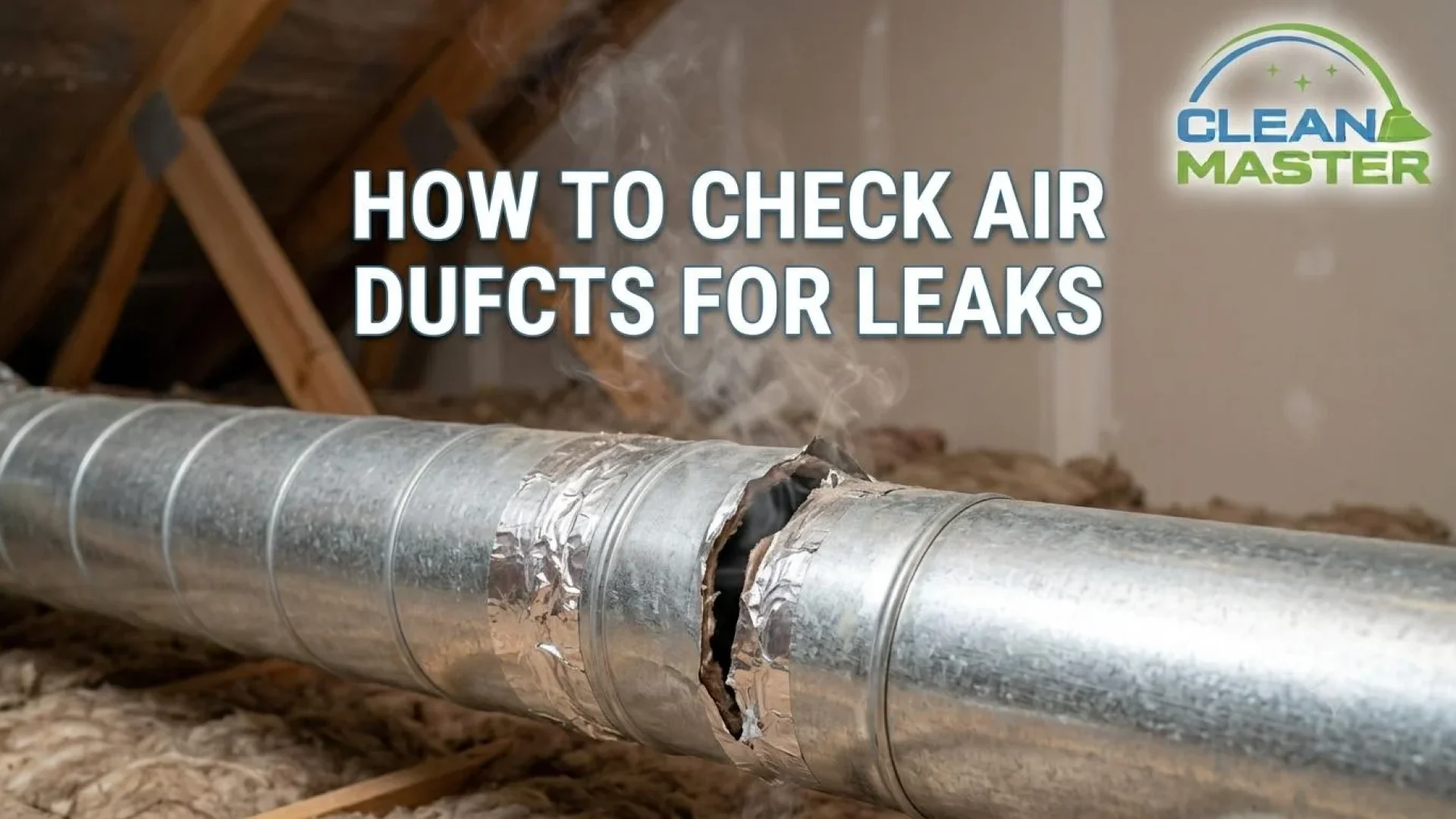
Duct leaks are one of the most consistently underestimated home efficiency and comfort problems in DFW, and one of the most common. The US Department of Energy estimates that the average home loses 20 to 30 percent of conditioned air through duct leaks before it reaches living spaces. In North Texas, where air conditioning runs for seven or eight months of the year, that’s a significant and continuous energy loss that shows up in utility bills and uneven home comfort.
At Clean Master Carpet Cleaning, air duct cleaning is one of our core DFW services, and duct condition is something we observe across a wide range of homes. Duct leaks are consistently more prevalent than homeowners expect, and consistently more impactful than they seem. Here’s how to check your own ductwork, what the signs tell you, and when the situation calls for professional attention.
Why Duct Leaks Matter More in DFW Than Most Climates
Before getting into detection, the consequences of duct leaks are worth understanding, because they affect more than just energy bills.
Energy efficiency loss is the most straightforward consequence. When conditioned air leaks out of supply ducts into an unconditioned attic or wall cavity before reaching the living space, the HVAC system has to run longer to achieve the thermostat setpoint. Every degree of cooling in a DFW summer costs energy, and leaking that cooling into an attic before it reaches the room multiplies the cost.
Air quality issues from unconditioned air infiltration are less obvious but equally significant. Return duct leaks, on the suction side of the system, draw in unconditioned air from attics, crawl spaces, and wall cavities. That air carries insulation particles, dust, mold spores from attic environments, and whatever else is present in unconditioned building cavities. It enters the duct system and gets distributed through the home with every HVAC cycle, bypassing the filter entirely.
Uneven heating and cooling is usually the symptom homeowners notice first. Rooms far from the air handler that are consistently harder to cool or heat than the rest of the house, despite the system running normally, are often experiencing the effect of supply duct leaks that reduce delivery pressure before air reaches those rooms.
Increased HVAC wear follows from the system running longer and harder to compensate for what’s being lost. In DFW’s demanding cooling season, this adds to compressor wear and shortens equipment life.
Signs Your Ducts May Be Leaking
Before any physical inspection, these whole-home observations are the first indicators:
- Rooms that are noticeably harder to cool or heat than others, particularly rooms furthest from the air handler
- Higher than expected energy bills without a clear explanation, a well-sealed, well-insulated DFW home should cool within a predictable energy cost range
- Dustier than usual indoor environment despite regular cleaning, return duct leaks drawing in attic air are a consistent cause of excess indoor dust
- Musty or stale smell when the HVAC runs, unconditioned attic or crawl space air entering through return leaks carries the odor of those spaces into the home
- HVAC system running almost continuously during moderate temperature days when it shouldn’t need to, a sign conditioned air is being lost before it reaches the thermostat
Any two or more of these in combination makes duct leak inspection worthwhile.
DIY Detection Methods
Method 1: Visual Inspection of Accessible Ductwork
Start with what you can see. Accessible ductwork, typically in the attic, basement, crawl space, or utility room, can be inspected visually for obvious leak indicators.
What to look for:
- Disconnected duct sections, flex duct that has separated from a collar, boot, or branch connection. These are complete separations that lose significant air volume and are immediately obvious once visible
- Damaged or compressed flex duct, flex ductwork that has been kinked, compressed, or torn. Kinks reduce airflow even without a full separation; tears leak directly
- Deteriorated duct tape at joints, standard grey duct tape peels and fails over time. Failed tape at joints and seams creates linear leaks along the connection
- Visible gaps at register boots, where the duct connects to the floor, wall, or ceiling register. Gaps here allow significant air loss directly into the wall or floor cavity
Walk accessible ductwork with a flashlight and check every visible connection, particularly joints, transitions, and where flex duct attaches to rigid metal sections.
Method 2: Hand or Incense Smoke Test at Joints and Seams
For leaks that aren’t visibly obvious, a hand test or incense smoke test while the HVAC is running reveals air movement at duct surfaces.
Hand test: Turn the HVAC to cooling or fan mode and allow the system to reach full airflow. Hold your hand near duct joints, seams, and connections, particularly at the air handler connections, plenum joints, and any taped seams in accessible sections. Moving air felt at a surface that should be sealed indicates a leak at that point.
Incense or smoke test: Light an incense stick and hold it near duct joints with the system running. The smoke stream will deflect toward a suction leak (return side) or away from a pressure leak (supply side). This visualizes small leaks that the hand test might miss and helps locate the specific point within a joint where air is escaping.
Work systematically along accessible ductwork, checking every joint rather than spot-checking. Small leaks can be in unexpected locations.
Method 3: Room Comfort and Airflow Comparison
This is the least technical method but one of the most practically useful for identifying which branch of the duct system is leaking.
With the HVAC running, visit each room in sequence and assess:
- Airflow from supply registers, hold your hand over the register. Rooms with significantly weaker airflow than similarly sized rooms suggest duct leaks on that branch reducing delivery pressure
- Temperature differential, a room that’s noticeably warmer in summer than adjacent rooms at the same distance from the air handler suggests supply duct leaks affecting that branch
- Register temperature vs. system setpoint, in cooling mode, supply air should feel noticeably cool at the register. Weak, barely-cool air from a distant register suggests significant duct loss between the air handler and that room
Map your findings, rooms with weak airflow and poor temperature control tend to cluster on branches that have leaks. This guides where to focus the physical inspection.
At a Glance: Detection Methods and What They Find
| Method | What It Finds | Best For |
| Visual inspection | Disconnected sections, obvious gaps, failed tape | Attic and accessible duct areas |
| Hand test at joints | Airflow at sealed surfaces indicating leaks | Supply and return connections |
| Smoke and incense test | Small leaks, leak direction (supply vs. return) | Precise leak location on accessible ductwork |
| Room comfort comparison | Branches with significant leakage | Identifying which rooms and branches are affected |
When to Call a Professional
DIY inspection identifies obvious and accessible leaks. What it can’t do:
- Quantify the total leak rate, professional duct blower door testing measures the exact percentage of air being lost, which determines whether sealing is cost-justified and confirms the improvement after sealing
- Access in-wall and ceiling duct sections, ductwork running through finished walls and ceilings isn’t accessible without opening the building envelope
- Seal leaks properly, mastic sealant and foil tape applied correctly by a professional provides durable, code-appropriate sealing. DIY sealing with standard duct tape fails within months
Professional duct sealing, either with mastic applied by hand or with Aeroseal (a pressurized sealant that seals from inside the duct system), addresses leaks throughout the full duct network including inaccessible sections. In DFW homes where duct systems run through hot attic spaces, professional sealing combined with duct insulation improvement can produce meaningful energy savings that pay back the service cost within a few cooling seasons.
Clean Master’s air duct cleaning service is a natural complement to duct sealing. Cleaning the system before sealing ensures the interior surfaces are clean, and Clean Master can advise on what we observe during cleaning that suggests leak points worth addressing. We serve the entire DFW area with air duct cleaning, carpet cleaning, upholstery cleaning, and tile and grout cleaning.
More Air Duct Guides
Frequently Asked Questions
How common are duct leaks in DFW homes?
Very common, particularly in homes built before 2000 where flex duct was installed with standard grey duct tape that has since failed. DFW’s attic temperatures, regularly above 140°F in summer, accelerate the deterioration of duct connections and tape. In our experience across DFW homes, meaningful duct leakage is present in the majority of homes over 15 years old.
Can I seal duct leaks myself?
Minor, visible leaks at accessible connections can be sealed DIY with UL 181-rated foil tape or mastic sealant, not standard grey duct tape. However, DIY sealing addresses only what’s visible and accessible, which is typically a fraction of total duct leakage. For comprehensive sealing that addresses the full system, professional service with blower door verification produces a more complete and measurable result.
Does Clean Master repair or seal air ducts?
Our air duct cleaning service focuses on cleaning the interior of the duct system. For duct sealing and repair, we recommend working with a licensed HVAC contractor or duct sealing specialist in DFW, and we’re happy to advise on what we observe during cleaning that suggests repair needs.
The Bottom Line: Check What You Can See, Then Act on What You Find
Visual inspection of accessible ductwork, hand and smoke tests at joints, and room-by-room comfort assessment together give a solid picture of where duct leaks are occurring and how significantly they’re affecting your home’s performance. In DFW’s demanding cooling climate, even moderate leakage has real consequences for comfort and energy cost.
When the inspection reveals more than DIY sealing can address, or when you want quantified results, professional duct sealing is the appropriate next step.
For the duct cleaning that precedes and complements duct sealing, contact Clean Master Carpet Cleaning today for professional air duct cleaning across the entire DFW area.