
Getting your carpet cleaned is the easy part. What happens in the hours after, how quickly and thoroughly the carpet dries, determines whether you end up with fresh, clean floors or a damp, musty problem that’s worse than what you started with.
Improper drying is one of the most common post-cleaning mistakes homeowners make, and the consequences range from re-soiling and residue to mildew growth in the carpet backing and subfloor beneath. As professional carpet cleaners serving the DFW area, drying is something we take as seriously as the clean itself. Here’s everything you need to know to do it right.
Why Drying Carpet Properly After Cleaning Matters
A freshly cleaned carpet holds more moisture than it looks like it does, particularly after DIY carpet cleaner use, where extraction power is lower than professional equipment. That moisture needs to move up and out of the fibers through evaporation. If it doesn’t, because airflow is poor, humidity is high, or foot traffic is pressing moisture back down into the pile, it migrates downward instead, into the carpet backing and the padding beneath.
Once moisture is trapped in the backing and padding, it doesn’t dry on its own. It creates warm, dark, damp conditions that are ideal for mildew and mold growth, neither of which announces itself immediately. By the time a musty smell becomes noticeable, the growth is already established and requires professional remediation to address properly. Read our guide on whether carpet cleaning can cause mold to understand how this happens and how to avoid it.
The good news: with the right approach, most carpets dry well within 6 to 24 hours, and the steps involved are straightforward.
Step 1: Remove Excess Surface Moisture First
Before you set up fans or open windows, address any excess moisture sitting at the carpet surface, especially if the carpet feels saturated or if you used a DIY machine that may have over-wetted the fibers.
Blot with Clean Dry Towels
For areas that feel particularly wet, press clean, dry towels firmly into the carpet and hold them in place for 30 to 60 seconds. The towels absorb surface moisture directly from the fibers before it has a chance to migrate deeper. Work from the outside of any wet area toward the center to avoid spreading moisture further.
Don’t rub, pressing and lifting is the technique. Rubbing pushes moisture deeper into the pile and can disturb carpet fibers that are more vulnerable when wet.
Replace towels as they become saturated and repeat until no more moisture transfers. This step is particularly valuable on thick or plush carpets where the pile holds more water close to the surface.
Step 2: Set Up Active Airflow
Airflow is the engine of carpet drying. Without it, moisture evaporating from the carpet surface has nowhere to go, it hovers in the air just above the fibers and slows evaporation dramatically. Active airflow moves that moisture-laden air out of the space and replaces it with drier air, keeping evaporation running at full speed.
Fans and Air Movers
Point fans directly at the carpet surface, not at the walls or ceiling, and run them continuously until the carpet is fully dry. Oscillating fans are useful for covering larger areas, but stationary fans aimed at the carpet surface move more air across the fibers where it matters most.
If you have access to a professional air mover, a low-profile, high-velocity blower fan, use it. Air movers move significantly more air volume than household fans and can cut drying time in half or better. Our DFW team sets these up as standard practice after every professional carpet clean, not as an optional extra, but as a core part of the service.
For large rooms or whole-home cleans, use multiple fans placed at intervals across the room rather than a single fan at one end.
Open Windows and Cross-Ventilation
When outdoor humidity is low, below 60%, opening windows is one of the most effective drying tools available. The goal is cross-ventilation: open windows on opposite sides of the room so air enters from one side and exits from the other, creating a continuous flow through the space.
Check outdoor humidity before opening up. In DFW summers, outdoor humidity regularly exceeds 70 to 80%, particularly in the morning and evening. Bringing that humid air inside slows drying rather than accelerating it. On high-humidity days, keep windows closed and rely on fans and your HVAC system instead.
In cooler, drier months, fall and winter in North Texas, open windows combined with fans is often the fastest drying combination available.
Step 3: Control Indoor Humidity
Moving air is essential, but the moisture content of that air matters just as much. In humid conditions, even a well-ventilated room can struggle to dry carpet quickly if the air itself is already carrying significant moisture.
Dehumidifiers
A dehumidifier removes moisture from the air, which lowers the humidity level in the room and accelerates evaporation from the carpet below. Place it in the same room as the damp carpet, keep the door closed to concentrate its effect, and empty the reservoir regularly, it will fill quickly in a room with wet carpet.
Run the dehumidifier in combination with fans for the most effective results. The fans move moisture away from the carpet surface; the dehumidifier removes it from the air before it can re-settle. In DFW summers, this combination is often the difference between carpet that dries in 8 hours and carpet that stays damp for 24.
How Long Should Carpet Take to Dry?
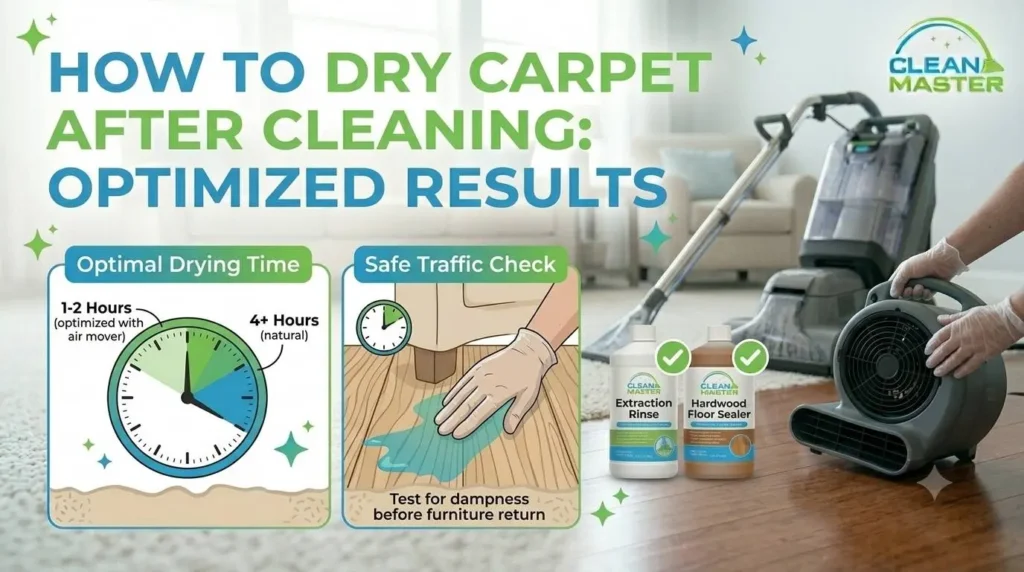
Drying time varies by cleaning method, carpet type, and conditions. Here are reliable benchmarks:
| Cleaning Method | Typical Drying Time | Notes |
| Professional hot water extraction | 6 to 12 hours | Faster with air movers set up post-clean |
| DIY carpet shampooer | 12 to 24 hours | Lower extraction = more moisture left behind |
| Steam cleaning | 1 to 3 hours | Least moisture introduced; fastest drying |
Thick or high-pile carpet adds 2 to 4 hours to any of the above. High humidity adds similar time. With active drying measures, fans, dehumidifier, and cross-ventilation, you can meaningfully compress these windows.
Mistakes That Slow Drying and Cause Damage
Not Removing Excess Moisture Before Drying
Skipping the blotting step on a saturated carpet and going straight to fans means you’re trying to evaporate water that could have been physically removed in minutes. The more surface moisture you extract manually at the start, the less work your fans and dehumidifier have to do, and the faster the carpet dries.
Walking on Carpet Before It’s Dry
Foot traffic on damp carpet compresses wet fibers, pushing moisture deeper into the pile and backing where it takes longer to evaporate. It also re-soils freshly cleaned fibers, oils and debris from bare feet and shoes transfer directly onto wet carpet far more readily than dry carpet. Stay off the carpet until it’s fully dry. Read our guide on when you can walk on carpet after cleaning for specific timing. If you need to cross the room, wear clean socks and step lightly.
Placing Furniture Back Too Early
Furniture legs on damp carpet trap moisture beneath them, preventing evaporation in those spots and creating conditions for mildew growth directly under the contact point. Metal furniture legs can also cause rust transfer, orange or brown stains on carpet fibers that are difficult to remove once set.
Wait until the carpet is completely dry before returning furniture. Read our guide on how long after carpet cleaning you can put furniture back for guidance. If you need to move pieces back sooner, place plastic furniture coasters, felt pads, or small squares of aluminum foil under each leg as a temporary barrier until drying is complete.
Closing Windows When Outdoor Humidity Is Low
This is the flip side of the open-windows advice above. On dry days, particularly in fall and winter, a closed room with no fresh air intake slows drying significantly. If outdoor humidity is low and temperatures are mild, open windows are one of your best tools. Check conditions before defaulting to a sealed room.
When to Be Concerned
A damp carpet for 6 to 24 hours is entirely normal. The point at which concern is warranted:
- Carpet still feels damp after 48 hours despite active drying measures
- A musty or mildew smell develops and doesn’t fade as the carpet dries
- The carpet smells worse after drying than it did immediately after cleaning
- Visible mold spots appear on or near the carpet surface
Any of these signs indicate that moisture has penetrated into the backing or padding, or that existing mold was disturbed by the cleaning and has conditions to grow. At this point, professional assessment is the right call. Drying measures alone won’t resolve mold that’s already established in the subfloor layers, and the longer it’s left, the more involved the remediation becomes.
As a DFW carpet cleaning company, we’re experienced in identifying and addressing post-cleaning moisture issues, including cases where DIY cleans have left too much water behind for standard drying to resolve.
Frequently Asked Questions
Should I turn on the heat to help carpet dry faster?
Warm air holds more moisture than cool air, which can help with evaporation, but only if that moisture has somewhere to go. Running heat in a closed room with no ventilation creates a warm, humid environment that actually slows drying. If you use heat, combine it with open windows or a dehumidifier to keep the moisture moving out of the space.
Can I speed up drying by running the AC?
Yes, air conditioning both cools and dehumidifies the air, making it an effective drying tool, particularly in DFW summers when windows can’t be opened due to outdoor humidity. Run AC in combination with fans pointed at the carpet surface for good results.
How do I know when the carpet is fully dry?
Press the back of your hand firmly into the carpet pile. If it feels cool and slightly damp, it’s not done. Fully dry carpet feels room-temperature and leaves no moisture on your hand. Check in multiple spots, particularly in high-pile areas and along edges near walls where drying tends to be slower.
The Bottom Line: Drying Is Part of the Clean
A great carpet cleaning job isn’t finished when the machine goes back in the closet, it’s finished when the carpet is fully dry. Blot excess moisture first, get active airflow going immediately, control humidity where you can, and keep foot traffic and furniture off until the carpet is completely dry.
Done right, most carpets are back to normal within 24 hours. Cut corners on drying, and you risk undoing everything the clean achieved.
If your carpet isn’t drying the way it should, or if you’re dealing with a moisture or mildew issue from a previous clean, our DFW carpet cleaning team is here to help. Contact our DFW carpet cleaning team today and let’s get your carpets clean, dry, and back to their best.