
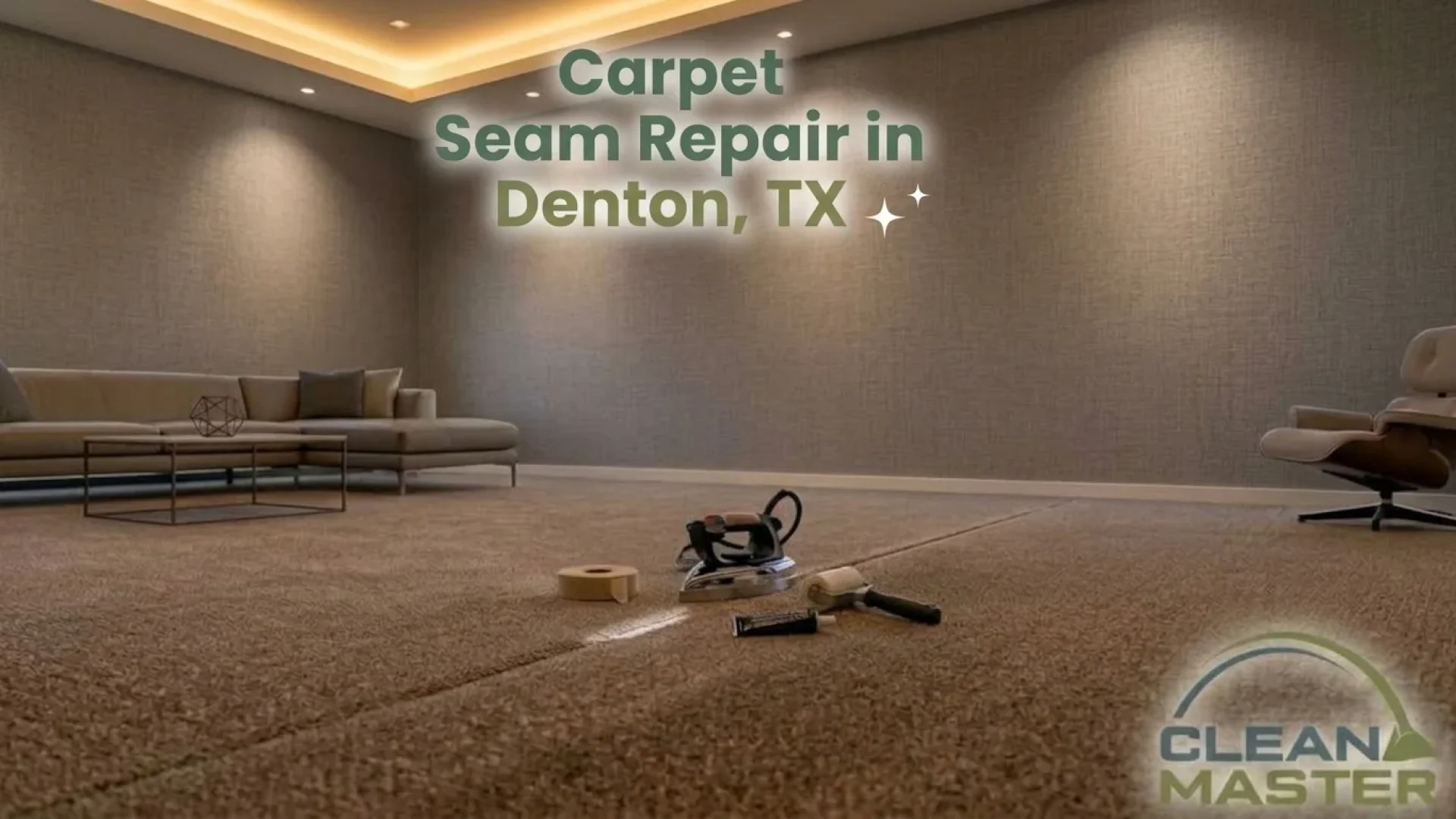
A carpet seam that starts to separate rarely stays small. It begins as a faint line you notice when the light hits the floor a certain way, then becomes a visible gap, then a frayed edge that snags on socks, vacuum cleaners, and bare feet. By the time the gap is wide enough to see the padding underneath, the repair is usually bigger than it needed to be.
The good news is that most split seams can be repaired without replacing any carpet. The better news is that the repair holds up far longer when the repair company understands why the seam failed in the first place. A seam that split because of foot traffic needs a different fix than one that split because the carpet was under-stretched during installation.
This guide from Clean Master Carpet Cleaning walks through the real causes of seam failure, how each cause is fixed, what you can safely try yourself, and what professional seam repair costs for homes in Denton, TX.
What a Carpet Seam Actually Is
Carpet is manufactured in wide rolls, commonly 12 feet across. Any room wider than that, or any space with an awkward shape, needs two or more pieces joined together. The joint where those pieces meet is the seam.
A well-made seam is built in a specific way:
- Seaming tape. A strip of heat-activated adhesive tape is placed under the joint.
- Heat. A seaming iron melts the adhesive so it bonds to the carpet backing on both sides.
- Pressure. The two edges are pressed together into the melted adhesive and held while it cools.
- Edge sealing. A sealant is applied along the cut edges so fibers do not fray or unravel.
When all of these steps are done well, a seam is nearly invisible and lasts for years. When any step is rushed or skipped, or when conditions in the home work against it, the seam becomes the weakest point in the whole floor.
Signs Your Carpet Seam Is Failing
Seam problems tend to announce themselves in stages. Catching them early keeps the repair small.
| Stage | What You Notice | Urgency |
| Early | A visible line where the seam sits, slight color or pile difference between the two sides | Low, but worth watching |
| Developing | Edges start to lift or peak, slight ridge you can feel underfoot | Moderate |
| Advanced | A visible gap, fraying edges, loose fibers, backing showing | High |
| Severe | Wide separation, padding exposed, edges curling or tripping hazard | Urgent |
A few specific warning signs to look for:
- A raised ridge along the seam that you can feel with your foot or see from a low angle
- Loose strands or fuzzy fibers collecting along the seam line
- A gap that is slightly wider this month than it was last month
- Seam edges that catch on vacuum cleaner brushes
- A seam that looks darker than the surrounding carpet because dirt is settling into the opening
Why Carpet Seams Split
Understanding the cause matters because the cause decides the fix. A repair that treats only the symptom, such as gluing a gap closed, often fails again within months if the underlying problem is still there.
Foot Traffic and Wear
Seams placed in hallways, doorways, and the main walking paths of a room take the most abuse. Every step puts slight stress on the adhesive bond, and over thousands of steps that stress adds up. Seams that cross a high-traffic path, rather than running alongside it, tend to wear out faster.
How it is fixed: The old tape and weakened adhesive are removed, the edges are trimmed clean, and a fresh seam is made with new tape and proper heat. In some cases, we recommend relocating the seam if it sits in the worst possible spot, though this depends on the carpet and room layout.
Poor Original Installation
This is one of the most common causes, and it often shows up within the first year or two. Installation problems that lead to seam failure include:
- Not enough adhesive on the seaming tape, or tape that cooled before the carpet was pressed into it
- Seam iron temperature that was too low or too high
- Edges that were not cut straight, leaving small gaps along the joint
- Edges that were not sealed, so fibers began fraying almost immediately
- Carpet that was not stretched correctly before or after seaming
How it is fixed: The seam is opened, cleaned, and rebuilt correctly. If the carpet was also under-stretched, we address that with power stretching so the new seam is not fighting tension from the start.
Moisture and Humidity
The adhesive used in seaming tape can soften when it is exposed to moisture over time. Spills that soak through to the seam, over-wet cleaning, pet accidents, and high humidity can all weaken the bond. Texas summers followed by drier winters also cause carpet backing to expand and contract, which puts extra strain on seams.
How it is fixed: First, any moisture problem has to be confirmed as resolved. We check the padding and subfloor near the seam. Once everything is dry and sound, the seam is rebuilt with fresh adhesive. If moisture damage has reached the padding, that section may need attention as well.
Age and Adhesive Breakdown
Seaming adhesive does not last forever. Over many years, heat cycles, foot traffic, and normal aging cause the bond to become brittle. Older carpet in homes that are ten, fifteen, or twenty years old often develops seam problems simply because the adhesive has reached the end of its useful life.
How it is fixed: Re-seaming with fresh tape restores the bond. If the carpet itself is badly worn or the backing has deteriorated, we will tell you honestly whether a repair makes sense or whether the carpet is near the end of its life.
Loose Tension and Stretching Problems
A seam is only as stable as the carpet around it. If the carpet has lost tension, it can shift and ripple, and that movement pulls on the seam. Wrinkles that form near a seam are often a sign that the whole room needs to be re-stretched, not just the seam repaired.
How it is fixed: We re-stretch the carpet with a power stretcher so tension is even across the room, then rebuild the seam so it is no longer under strain. Repairing the seam without addressing tension usually means the seam reopens.
Snags and Pulled Loops
Loop pile carpets, including many Berber styles, have a specific weakness. If a single loop catches on something, such as a pet claw, a piece of furniture, or a vacuum brush, it can pull out a run of loops. When that happens near a seam, the run can travel along the seam line and open it up.
How it is fixed: The pulled loops are secured or trimmed, and any gap is repaired. In some cases, a small patch is used to replace missing fibers, and the seam is re-secured so the run cannot continue.
Furniture and Appliance Movement
Dragging heavy furniture, rolling appliances, or moving a piano or large bookcase across a seam puts sideways force on the adhesive. Even a single move can separate a seam that was already aging.
How it is fixed: The seam is rebuilt, and we recommend furniture sliders or lifting heavy pieces rather than dragging them across seams in the future.
Vacuum Brush and Pet Damage
Aggressive vacuum brush rolls can catch on the raised edge of a weak seam and pull it further apart. Pets that scratch or dig at a seam can speed up fraying, especially along an edge that is already lifting.
How it is fixed: The seam is repaired and edge sealed. Adjusting the vacuum height and keeping pets away from the area while it settles both help the repair last.
Causes at a Glance
| Cause | Typical Warning Sign | Best Fix |
| Foot traffic | Seam wears out in hallways and doorways | Re-seam with fresh tape and heat |
| Poor installation | Seam fails within 1 to 2 years | Rebuild seam, check and correct stretch |
| Moisture | Soft or discolored seam, musty smell | Confirm dry subfloor, then re-seam |
| Age | Brittle adhesive, older carpet | Re-seam, or evaluate replacement if carpet is worn out |
| Loose tension | Ripples near the seam | Power stretch, then rebuild seam |
| Snagged loops | Run of pulled fibers along seam | Secure loops, patch gaps, re-seam |
| Furniture movement | Sudden gap after moving furniture | Rebuild seam, use sliders going forward |
| Vacuum or pet damage | Fraying edges, lifted corners | Seal edges, re-seam, adjust habits |
How Denton’s Climate Affects Seams
North Texas weather is hard on carpet seams. Long, hot summers keep air conditioning running for months, and the swing between humid stretches and dry winter air makes carpet backing expand and contract year after year. That repeated movement slowly works on seaming adhesive, which is one reason seams in older Denton homes often fail even when the original installation was done well.
A few local factors are worth keeping in mind:
- Seasonal humidity swings stress adhesive bonds and backing over time
- Active, busy households with kids and pets put extra wear on seams in main walking paths
- Older homes are more likely to have seams that are simply past the life of their adhesive
- Rental turnovers often reveal seam problems that were hidden under furniture for years
None of this changes how the repair is done, but it explains why checking seams periodically is a good habit in this climate.
How We Repair Carpet Seams in Denton
Our repair visits follow a consistent process, adjusted to what the inspection finds.
- Inspection. We look at the seam, the carpet on both sides, the padding underneath, and the general tension of the room. This is where we identify the cause, not just the symptom.
- Diagnosis. We explain what we found and recommend the right fix, whether that is a simple re-seam, a seam repair with a small patch, or a repair combined with stretching.
- Opening the seam. The carpet is carefully lifted along the seam, and old tape and failed adhesive are removed.
- Edge preparation. Frayed or uneven edges are trimmed straight so the two pieces meet cleanly.
- Re-seaming. Fresh seaming tape goes down, the adhesive is heated, and the edges are pressed together and held until the bond sets.
- Edge sealing. Sealant is applied along the cut edges to prevent fraying.
- Pile blending. Fibers along the seam are worked so the joint blends into the surrounding carpet.
- Final check. We inspect the seam from standing height and at low angles in natural light to confirm it lies flat and looks consistent.
Most single seam repairs are completed in under two hours.
What to Expect on Repair Day
A little preparation helps the visit go smoothly:
- Clear the area. Moving small furniture and items away from the seam gives the technician room to work.
- Point out the problem. Tell us when you first noticed the seam and whether anything changed, such as a furniture move or a spill.
- Mention history. Let us know if the carpet was installed recently or if the seam has been repaired before.
- Plan for minimal disruption. Most seam repairs do not require leaving the home, and the room can usually be used again right after the repair.
Carpet Styles and Seam Behavior
Different carpet constructions respond to seam problems in different ways.
| Carpet Style | Seam Behavior | Repair Consideration |
| Cut pile (plush, saxony) | Seams usually blend well when repaired | Pile direction must match on both sides |
| Loop pile (Berber) | Prone to pulled loops running along the seam | Secure loops before re-seaming |
| Frieze | Twisted fibers hide seams well | Easiest to blend after repair |
| Patterned carpet | Pattern must line up across the joint | Takes more time and precision |
DIY Fixes for Minor Seam Fraying
If the seam is intact but a few fibers are fuzzing along the edge, a small DIY step can keep it from getting worse. This is only suitable for very minor fraying, not for open gaps or lifted seams.
What you can try:
- Trim loose strands with small, sharp scissors, cutting level with the pile. Never pull on loose strands, because pulling can unravel more fibers.
- Apply a small amount of carpet seam sealer along the frayed edge, following the product directions.
- Let it dry fully before walking on it.
- Lower or raise your vacuum brush height so the roller does not catch the seam edge.
What not to do:
- Do not use super glue or household adhesives, which dry hard and can make the edge brittle and visible.
- Do not pull or tug on loose fibers.
- Do not iron the carpet. Household irons can melt synthetic fibers.
- Do not try to rebuild an open seam without proper seaming tape and a seam iron.
When to Call a Pro Instead
Stop DIY and request a repair if:
- The seam has an open gap, even a narrow one
- The edges are lifting or peaking
- You can see padding or backing through the seam
- The seam keeps reopening after you fix it
- The seam sits in a hallway, entryway, or other high-traffic area
- There are ripples or wrinkles near the seam
A poorly done DIY seam fix can make the professional repair harder, because old glue and damaged edges have to be cleaned up before the seam can be rebuilt properly.
Carpet Seam Repair Cost in Denton, TX
Pricing depends on seam length, the cause of failure, and whether patching or stretching is needed as well. As a general guide:
| Repair Type | Typical Price Range |
| Short seam repair or re-seam | $50 to $100 |
| Longer seam or seam in a high-traffic area | $100 to $150 |
| Seam repair with a small patch | $100 to $250 |
| Seam repair combined with power stretching | $150 to $300 |
Exact pricing depends on the carpet type, the condition of the seam, and how easy it is to match fibers if a patch is needed. A free quote gives the most accurate number for your specific seam. Check our current specials for available savings.
Our Workmanship Warranty
Clean Master Carpet Cleaning backs our repair work with a workmanship warranty. If a seam we repaired reopens in the repaired area during the warranty period because of our workmanship, we will come back and make it right.
Because we diagnose the cause before we repair, our seam repairs are built to address the real reason the seam failed, not just close the gap temporarily.
When Replacement Makes More Sense
Repair is the right call in most situations, but a few conditions point toward replacement:
- Multiple seams are failing across the same room, which often signals widespread adhesive failure or badly worn carpet
- The carpet backing has deteriorated and no longer holds adhesive
- Water damage or mold has affected the padding or subfloor beneath the seam
- The carpet is so worn that repairing one area would leave it looking obviously different from the rest
- Matching material is no longer available and a patch is needed
If any of these apply, we will say so honestly during the inspection rather than recommending a repair that will not last.
How to Keep Seams From Splitting Again
A good repair lasts longer when the home habits that stressed the seam are addressed.
| Habit | Why It Helps |
| Use furniture sliders | Prevents sideways force on seams when moving heavy items |
| Lift, do not drag, heavy items | Protects the adhesive bond from sudden stress |
| Set vacuum height correctly | Keeps brush rolls from catching seam edges |
| Place rugs over high-traffic seams | Reduces direct wear on the joint |
| Clean spills promptly | Prevents moisture from reaching and weakening the adhesive |
| Avoid over-wetting during cleaning | Keeps adhesive from softening |
| Address ripples early | Prevents tension problems from pulling on the seam |
Questions to Ask Any Seam Repair Company
Before you book, these questions help you compare providers:
- Will you identify why the seam failed, or just close the gap?
- Do you use proper seaming tape and a seam iron, not household adhesives?
- Do you seal the cut edges after re-seaming?
- Can you match my carpet if a patch is needed?
- Is the repair backed by a warranty?
- Will you check whether the carpet needs stretching as well?
A company that answers these clearly and specifically is generally a safer choice than one that offers a quick, vague fix.
Pairing Seam Repair With Regular Carpet Care
A repaired seam is a good moment to think about the rest of the floor. Seams collect dirt faster than the surrounding carpet because even a tight joint is a slightly different texture, so keeping up with professional carpet cleaning helps protect both the seam and the fibers around it. Many homeowners schedule a cleaning shortly after a repair so the whole room looks consistent. If you are also dealing with ripples, a stretch can be handled in the same visit, and our guide to upholstery cleaning is worth a look if furniture in the same room needs a refresh too.
Frequently Asked Questions
Can a split carpet seam be repaired without replacing the carpet?
Yes, in most cases. A seam repair rebuilds the joint using fresh seaming tape and heat, and it does not require removing or replacing the carpet on either side as long as the carpet and padding are in reasonable condition.
Why did my carpet seam split so soon after installation?
Seams that fail within the first year or two usually point to an installation issue, such as insufficient adhesive, incorrect seaming iron temperature, unsealed edges, or carpet that was not stretched properly. A repair should address the original cause, not just close the gap.
How much does carpet seam repair cost in Denton, TX?
Most seam repairs fall between $50 and $150, with seam repairs that include patching or stretching ranging up to about $300. A free quote gives the most accurate price for your specific seam.
How long does a carpet seam repair take?
Most single seam repairs are finished in under two hours. Longer seams, patch work, or repairs combined with stretching can take a bit longer.
Can I fix a carpet seam myself?
Very minor fraying can sometimes be managed by trimming loose fibers and applying seam sealer. Open gaps, lifted edges, and seams in high-traffic areas need proper seaming tape and a seam iron, which is why professional repair gives a more reliable result.
Is there a warranty on carpet seam repair?
Yes. Clean Master Carpet Cleaning offers a workmanship warranty on repair work. If the repaired seam reopens during the warranty period because of our workmanship, we will return and fix it.
What causes carpet seams to come apart?
Common causes include foot traffic, poor installation, moisture, aging adhesive, loose carpet tension, snagged loops, furniture movement, and vacuum or pet damage. Identifying the specific cause is what makes a repair last.
Will the repaired seam be visible?
When the edges are trimmed cleanly, the seam is rebuilt properly, and the pile is blended along the joint, a repaired seam should be hard to notice. Some very subtle visibility can remain on certain carpet styles, especially patterned or loop pile carpet.
Should I repair a seam or replace the carpet?
Repair is usually the better choice when the damage is isolated and the carpet is in decent shape. Replacement makes more sense when multiple seams are failing, the backing has deteriorated, or moisture damage has affected the padding or subfloor.
Do I need to leave my home during a seam repair?
No. Most seam repairs are quick and do not require leaving the home, and the room can usually be used again once the repair is finished.
Why does my seam look darker than the rest of the carpet?
Dirt settles into even a small opening along a seam, and the slightly different texture of a seam collects soil faster than the surrounding carpet. Cleaning can help, but a visibly open seam should be repaired so dirt stops collecting inside the gap.
Get a Free Carpet Seam Repair Quote in Denton, TX
If you have a seam that is separating, fraying, or lifting, do not wait for it to get worse. Clean Master Carpet Cleaning has been repairing and caring for carpet across the Dallas-Fort Worth area, including Denton, for over 26 years, backed by our workmanship warranty.
Request a free quote and we will help you figure out why your seam failed and the right way to fix it. Learn more about our team and our approach to carpet care across Denton and the surrounding area.