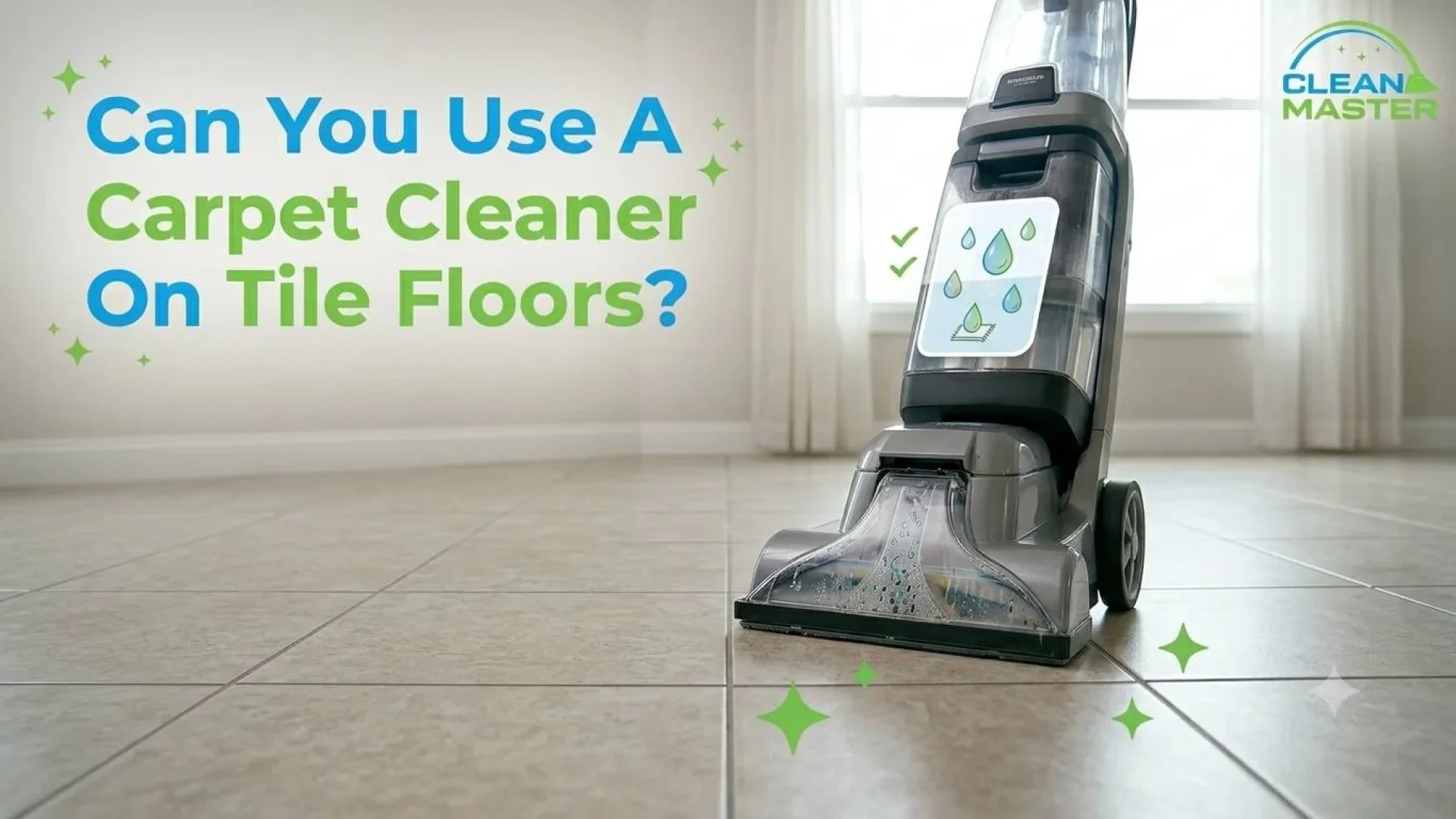
The carpet cleaner is already out, the tile needs cleaning, and it’s tempting to run the machine across both surfaces in the same session. It seems efficient. It probably won’t cause obvious immediate damage. And that’s exactly what makes this a problem worth addressing, because the consequences of using a carpet cleaner on tile are real, they’re progressive, and they’re visible before most homeowners connect the cause.
At Clean Master Carpet Cleaning, tile and grout cleaning is one of our core DFW services. Here’s the straightforward answer to whether a carpet cleaner belongs on your tile floors, by tile type, by risk, and with the alternatives that actually do the job right.
Why Carpet Cleaners Aren’t Designed for Tile
Carpet cleaning machines, whether consumer hot water extractors, rental machines, or professional truck-mounts, are engineered around one surface: carpet fiber. Everything about the chemistry, the water volume, the spray pattern, and the head design is optimized for penetrating and extracting from dense fiber.
Tile is the opposite surface. It’s hard, non-porous at the face, and requires cleaning chemistry that stays at the surface rather than penetrating it. The two surface types need fundamentally different approaches, and the mismatch between carpet cleaning equipment and tile surfaces creates three specific problems that compound over time.
The Risks: By What They Do to Your Tile
Residue Buildup on the Tile Surface
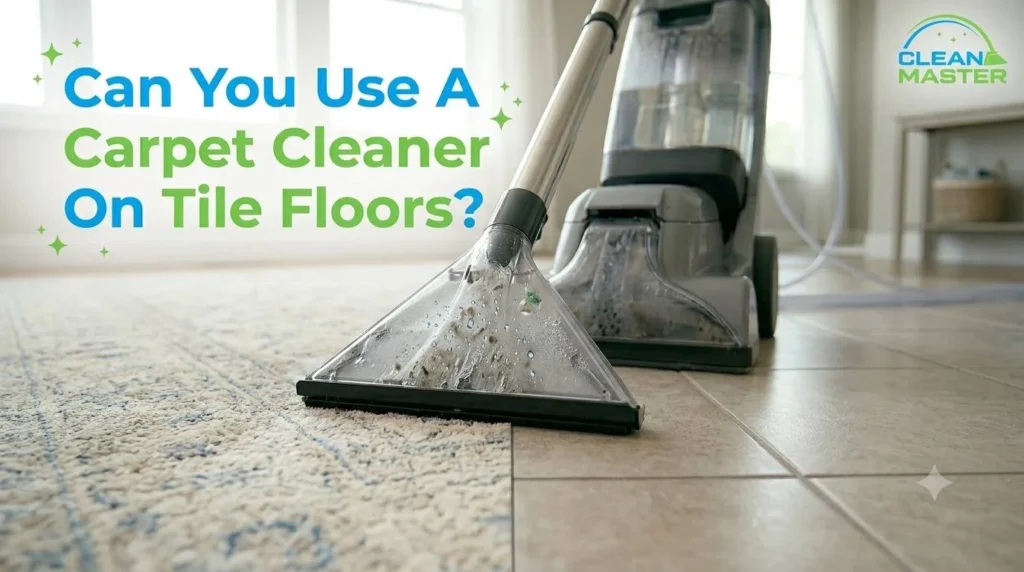
Carpet cleaning solutions are formulated with surfactants designed to penetrate fiber and rinse out during extraction. On carpet, the extraction pass pulls the solution and the soil it’s carrying back out of the fiber. On tile, there’s no fiber to hold the solution during the cleaning pass, and the extraction head on a carpet cleaner isn’t designed to make flush contact with a hard, flat surface.
The result is carpet cleaning solution that’s applied to the tile surface, incompletely extracted, and left to dry in place. As it dries, the surfactant compounds concentrate and leave a film on the tile that:
- Attracts dust and foot traffic debris, the same residue issue that causes re-soiling on carpet happens faster on tile because the surface is smooth and every particle that contacts it sticks
- Creates a dull, cloudy appearance, particularly visible on glazed ceramic, polished porcelain, and any tile with a reflective finish
- Builds up with each repeated application, a single carpet cleaner pass on tile may leave light residue that’s not immediately obvious; repeated use over weeks or months creates visible film that standard mopping doesn’t remove
Over-Wetting Grout and Moisture Infiltration
Grout is porous. A carpet cleaner’s spray pattern introduces water volume calibrated for carpet fiber, more moisture than tile grout can safely absorb and release in normal drying conditions.
When carpet cleaner solution is applied to tile and grout at carpet-cleaning water volumes:
- Unsealed grout absorbs the solution, carrying surfactant compounds into the grout pores where they dry in place, progressively darkening the grout and making it more difficult to clean effectively over time
- Sealed grout is partially protected, but excess moisture at the seam between the tile and grout line can work underneath the sealant at edges, compromising the seal and creating entry points for future moisture infiltration
- In bathrooms and wet areas where grout already manages moisture regularly, additional water volume from a carpet cleaner applied without appropriate extraction contributes to the cumulative moisture load that eventually causes grout to crack, crumble, or develop mold beneath the surface
Slippery Tile Surface from Soap Residue
This is the risk with immediate safety implications. Carpet cleaning surfactant residue on tile creates a low-friction surface, particularly on smooth ceramic, polished porcelain, and glazed tile in wet environments like bathrooms and kitchens.
The slippery effect is most pronounced when the tile is wet, after showering, after mopping, or when any liquid contacts the residue-coated surface. It’s not always dramatic enough to cause an obvious slip, but it reduces traction meaningfully in exactly the environments where bathroom and kitchen tile needs to perform safely underfoot.
This risk is separate from the cleaning performance issue, it’s a safety concern that applies regardless of how clean the tile looks after a carpet cleaner pass.
How Each Tile Type Responds
| Tile Type | Primary Risk | Secondary Risk | Overall Verdict |
| Ceramic (glazed) | Residue dulling the glaze | Surfactant buildup in grout | Not recommended |
| Porcelain (polished) | Residue visible on reflective surface | Slip hazard when wet | Not recommended |
| Porcelain (textured/matte) | Residue trapped in surface texture | Grout over-wetting | Not recommended |
| Natural stone (marble, travertine) | Alkaline carpet cleaner solution etches surface | Moisture infiltration through pores | Strongly avoid |
| Grout lines (any tile) | Surfactant absorbed into pores | Moisture over-saturation | Not recommended |
A Note on Natural Stone
Natural stone tile, marble, travertine, limestone, slate, deserves specific mention because the risk isn’t just residue and moisture. It’s chemistry.
Most carpet cleaning solutions run at an alkaline pH to break down the acidic compounds in carpet soils. Marble and travertine are calcium carbonate-based, they react with alkaline chemistry in a process called etching, which dissolves the surface of the stone and creates dull, rough patches that can’t be buffed out without professional stone restoration. A single carpet cleaner pass on marble tile can cause visible etching. Repeated applications progressively damage the surface in ways that become increasingly expensive to address.
Natural stone tile and carpet cleaning solution are categorically incompatible. If your home has natural stone tile, the conversation about what cleaning product touches it starts and ends with pH-neutral, stone-safe chemistry.
What to Use on Tile Floors Instead
Purpose-Made Tile and Grout Cleaner With a Microfiber Mop
For regular maintenance of ceramic and porcelain tile, a pH-appropriate tile cleaner applied with a microfiber mop is the correct everyday tool. The tile cleaner is formulated for hard surface chemistry, not carpet fiber chemistry, and rinses cleanly from the tile surface without leaving the residue that carpet cleaning solution deposits.
Application technique matters on tile: spray the cleaner onto the mop pad rather than directly onto the floor to prevent pooling in grout lines, work in sections, and use a dry mop or dry microfiber pass to collect the lifted soil before it redeposits as the cleaning solution evaporates.
For natural stone, pH-neutral stone cleaner is non-negotiable, no acidic or alkaline products regardless of how mild they seem.
Steam Mop for Tile Sanitizing
A steam mop is one of the safest and most effective tools for tile maintenance, it sanitizes through heat rather than chemistry, leaves no residue, and works on ceramic and porcelain without concern for chemical incompatibility. The steam loosens surface grime and dried residue effectively, and the microfiber pad on most steam mop heads collects the loosened material in the same pass.
For natural stone, check the manufacturer’s guidance before steam mopping, some stone types are sensitive to the heat and moisture combination, and the specific stone and its sealing status affect whether steam mopping is appropriate.
Steam mopping maintains tile between professional deep cleans but doesn’t replace the pressure and extraction that removes embedded grout contamination. Read our guide on whether steam cleaning is safe for tile and grout for a full breakdown by tile type.
Rental Tile Cleaning Equipment
For homeowners who want a DIY deep clean beyond what a mop can accomplish, rental tile floor scrubbers, available at Home Depot and Lowe’s locations across DFW, are purpose-built for hard surface cleaning. They use rotary brush action appropriate for tile surfaces and work with tile-specific cleaning solution rather than carpet chemistry. Read our guide on renting a tile and grout cleaner for what to expect from rental equipment.
Professional Tile and Grout Cleaning From Clean Master
For grout that has visibly discolored, tile that has accumulated residue buildup from previous incorrect product use, or natural stone that needs professional chemistry and technique, Clean Master’s tile and grout cleaning service is the right call.
Our professional tile cleaning uses high-pressure hot water extraction through rotary cleaning heads designed specifically for hard surfaces, completely different from carpet cleaning equipment in both design and chemistry. We match the cleaning solution to the tile type before anything is applied, extract thoroughly, and offer grout sealing after cleaning to protect the result.
We serve the entire DFW area with tile and grout cleaning, carpet cleaning, upholstery cleaning, and air duct cleaning, and the distinction between surfaces matters to us as much as it should matter to the homeowner deciding which tool to use.
Frequently Asked Questions
What if I accidentally already used a carpet cleaner on my tile?
The immediate step is to mop the tile thoroughly with clean warm water to dilute and remove as much residual carpet cleaning solution as possible. Follow with a second clean water pass and allow the tile to dry fully. Assess once dry, if a residue film or dullness is visible, a tile-appropriate cleaner applied with a microfiber mop will address mild buildup. For significant residue accumulation or any etching on natural stone, professional tile cleaning is the appropriate next step.
My carpet cleaner has a hard floor attachment. Does that make it safe for tile?
Hard floor attachments change the spray and collection pattern of a carpet cleaner to suit hard surfaces better than a standard carpet head. They reduce some of the over-wetting risk and improve solution recovery on flat surfaces. However, they don’t change the chemistry of the cleaning solution, carpet cleaning solution is still the wrong product for tile regardless of which head is attached. If you use a carpet cleaner’s hard floor attachment on tile, use plain water rather than carpet cleaning solution to avoid the residue and chemistry problems described above.
Can I use a Rug Doctor or Bissell Big Green on tile?
These are hot water extractors designed for carpet, the solution formulations included and recommended for them are carpet chemistry. Using them on tile with their standard solutions creates the residue and chemistry problems above. On a practical level, the carpet head also doesn’t make efficient contact with flat tile surfaces, making cleaning ineffective as well as chemically inappropriate. These machines belong on carpet; tile needs its own tools.
The Bottom Line: Carpet Cleaners Belong on Carpet
The efficiency of cleaning both surfaces in the same session with the same machine isn’t efficiency, it’s trading a time saving now for residue buildup, over-wetted grout, a slip hazard on the tile surface, and potential chemistry damage on natural stone. None of those outcomes are reversible without effort, and some require professional correction.
Tile gets its own tools: a purpose-made tile cleaner and microfiber mop for maintenance, a steam mop for sanitizing, and Clean Master’s professional tile and grout cleaning when the floor needs a genuine deep clean. Contact Clean Master Carpet Cleaning today for professional tile and grout cleaning across the entire DFW area and the right treatment for every surface in your home.