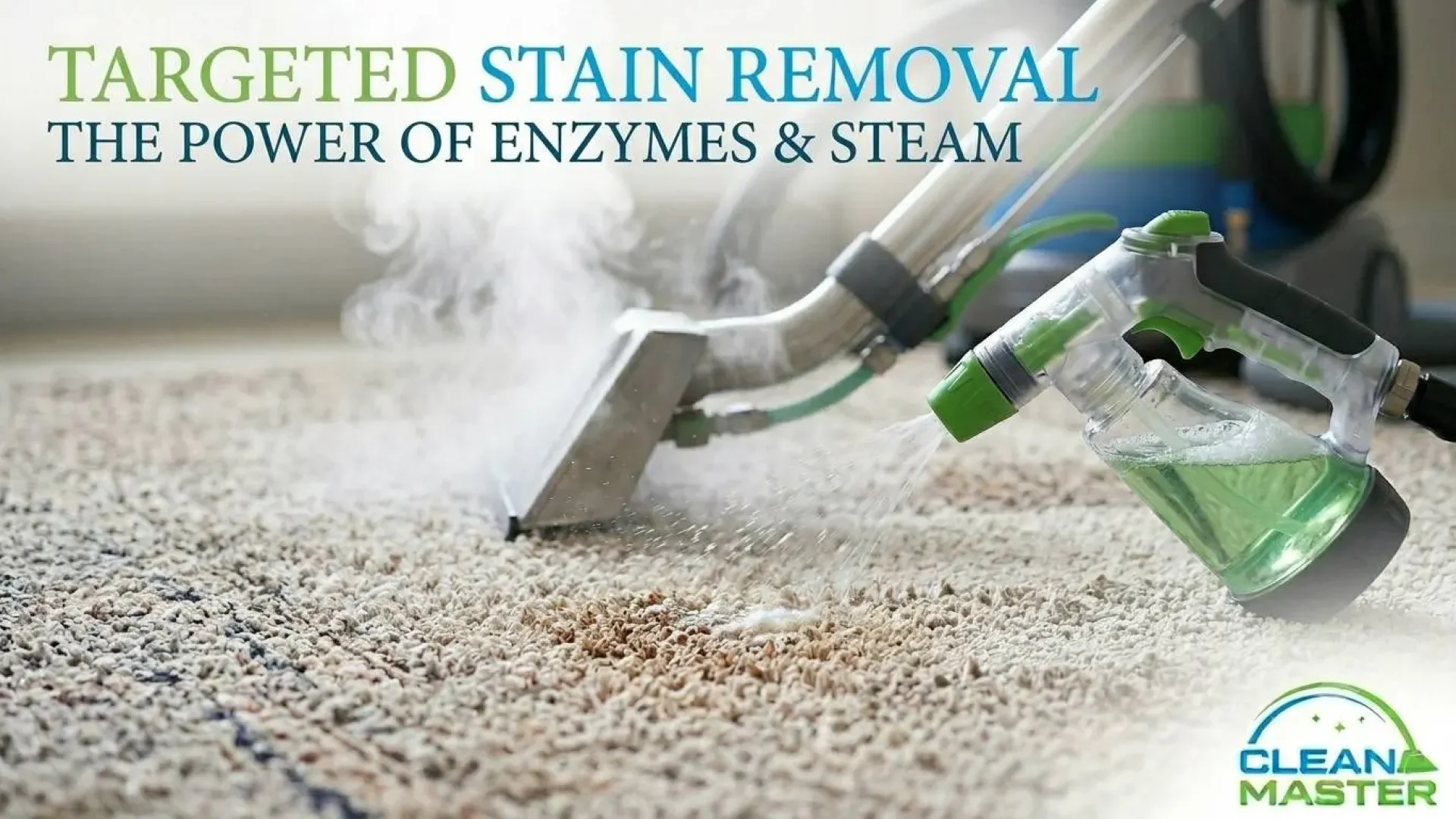
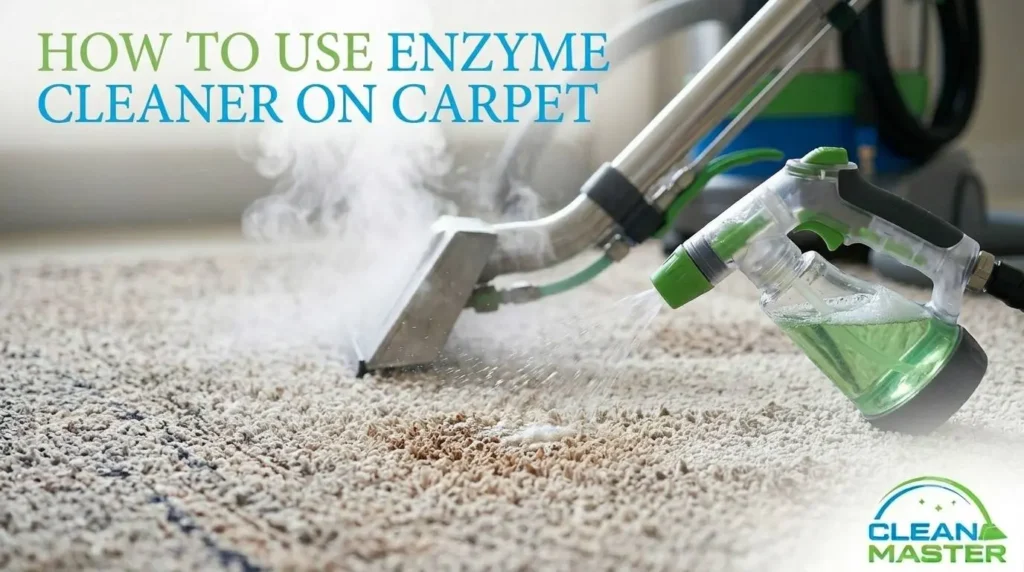
Enzyme cleaners have developed a strong reputation in the carpet cleaning world, and it’s well-deserved, for the right problems. Pet urine, vomit, blood, and other organic stains and odors respond to enzyme treatment in ways that standard carpet cleaners simply can’t match. The chemistry is genuinely impressive.
The frustration most homeowners run into isn’t with the product, it’s with the results when the product isn’t used correctly. At Clean Master Carpet Cleaning, dwell time is the single factor we come back to most often when clients tell us enzyme cleaner didn’t work for them. In most cases it did work, just not fully, because the process was cut short.
Here’s what enzyme cleaners actually do, where they work best, and the technique details that separate results that impress from results that disappoint.
What Enzyme Cleaners Actually Do and Why It Matters for Technique
Understanding the mechanism behind enzyme cleaners isn’t just interesting, it directly informs how to use them correctly.
Enzyme cleaners contain cultures of beneficial bacteria that produce specific enzymes when they contact organic material. Those enzymes break down the molecular structure of the organic compound, uric acid in pet urine, proteins in blood and vomit, fatty acids in food stains, converting them into water, carbon dioxide, and simple compounds that evaporate or rinse away cleanly.
The critical implication: this is a biological process, not a chemical reaction that happens on contact. The bacteria need time to produce enzymes, the enzymes need time to break down the target compound, and the whole process requires the right conditions, moisture, temperature, and uninterrupted contact with the organic material, to complete.
This is why rushing enzyme treatment produces disappointing results. The product hasn’t failed. The process hasn’t finished.
Where Enzyme Cleaners Work Best
Pet Urine and Odor
This is the use case enzyme cleaners were essentially built for, and the one where the difference between enzyme treatment and everything else is most dramatic.
Pet urine contains uric acid crystals that bond to carpet fibers and backing. Standard cleaning products address the surface, removing visible staining and masking immediate odor, but leave the uric acid crystals intact. Those crystals are what cause pet odor to return after cleaning, often more intensely than before, as heat and humidity reactivate them.
Enzyme cleaners are the only treatment that breaks down uric acid crystals at a molecular level. Used correctly, they eliminate the odor source rather than masking it, which is why the smell doesn’t return after a proper enzyme treatment the way it does after standard cleaning. Read our guide on does steam cleaning carpet remove odor to understand why steam alone can’t replace enzyme treatment for pet urine.
The depth of penetration required is also important here. Pet urine doesn’t stay in the carpet pile, it flows through to the backing and often into the padding beneath. Enzyme cleaner needs to reach the same depth the urine did, which means applying enough product to saturate to that level, not just dampen the surface fibers.
Vomit and Bodily Fluid Stains
Vomit, blood, and similar bodily fluid stains are protein-based, and enzymes that target proteins break them down effectively where scrubbing and standard cleaners leave residue and odor behind.
The key with these stains is sequence. Remove as much of the physical material as possible first, scoop, blot, and remove solids and excess liquid before any cleaner is applied. Applying enzyme cleaner to a heavily loaded stain means the product is working through a thick layer of material rather than penetrating to the fiber level. The less material on the surface when the enzyme cleaner goes on, the more effectively it can reach and treat what’s bonded to the fibers beneath.
For blood specifically: use cold water to blot the stain before enzyme treatment. Hot water or steam applied to protein stains before enzyme treatment coagulates the protein into the fiber, making the job significantly harder. Cold water keeps the protein mobile; the enzyme cleaner breaks it down.
General Organic Stains and Odors
Food odors, general pet smells, musty carpet odor from organic buildup, enzyme cleaners address the source of these rather than masking them with fragrance. For carpet that has developed a persistent smell that regular cleaning doesn’t fully resolve, an enzyme treatment applied broadly to the affected area and allowed to dwell fully often produces a noticeable improvement that outlasts any deodorizing spray. Read our guide on why carpet smells worse after cleaning if odor issues persist after treatment.
The Tips That Make the Difference
Give It Enough Dwell Time, More Than the Label Says
This is the make-or-break factor, and it’s where most DIY enzyme cleaning falls short. Product labels typically suggest 5 to 10 minutes of dwell time. In our experience and in the feedback we regularly get from DFW clients, this is a minimum for light, recent stains on surface fibers. For anything older, deeper, or more concentrated, longer is better.
For fresh pet urine or vomit on carpet, allow 10 to 15 minutes minimum. For dried or set pet urine, allow 20 to 30 minutes or longer. For recurring odor from repeated accidents in the same area, consider covering the treated area with plastic wrap after applying the product to prevent evaporation and extend the active dwell period to several hours.
The bacteria in enzyme cleaners are living organisms, they need moisture to stay active. If the product dries out before the process is complete, the treatment stops mid-way. Keeping the area moist during extended dwell time via plastic wrap or a damp cloth placed over it is one of the most effective technique upgrades available for difficult stains.
We’ve had clients who treated the same pet urine spot three or four times with short dwell times and got partial results each time. Switching to a single treatment with a 30-minute covered dwell time resolved what repeated short treatments hadn’t. The product wasn’t the issue, the process was.
Use Enough Product
Under-applying enzyme cleaner is the second most common mistake after insufficient dwell time. The amount needed isn’t a light mist, it’s enough to saturate the carpet fibers to the depth the stain has penetrated.
For surface stains and general odors, generous saturation of the visible affected area is appropriate. For pet urine, which penetrates to the backing and padding, the product needs to be applied in a volume that reaches that same depth. A rough guide: if the original accident would have visibly soaked the carpet, the enzyme treatment needs similar volume to reach the same layers.
If you’re uncertain whether you’ve applied enough, err toward more. Unlike some cleaning products, enzyme cleaners don’t leave harmful residue when used as directed, the bacteria and their byproducts are safe and non-toxic.
Never Apply Over Other Cleaning Products
This is a mistake that neutralizes enzyme treatment before it begins. Many household cleaners, particularly those containing bleach, quaternary ammonium compounds, or high-alkalinity formulas, kill the bacteria in enzyme cleaners on contact. If you’ve already sprayed a standard cleaner, a disinfectant, or a deodorizer on the stain before reaching for the enzyme cleaner, those products are likely to inactivate the enzymes.
The correct sequence is: remove physical material, blot excess liquid, apply enzyme cleaner. Nothing else on the stain before the enzyme treatment goes on. If you’ve already used another product, rinse the area thoroughly with clean water, blot dry as much as possible, and allow it to dry fully before applying the enzyme cleaner to a clean starting point.
Don’t Rinse Too Quickly
Rinsing before the enzymatic process is complete washes away the active bacteria and enzymes before they’ve finished breaking down the target compound. Whatever they haven’t yet converted leaves the same residue and odor potential as if no treatment had been applied.
After the full dwell time, blot the treated area with clean dry towels to absorb the product and the broken-down material it’s carrying. Then rinse lightly with clean water and blot again. The goal is to remove the spent product and residue, not to flood the area with water that would dilute any still-active enzyme treatment in deeper layers.
For deep stains and pet urine that has penetrated to the padding, a light water rinse after blotting is better than no rinse, but keep it minimal and extract as much moisture as possible before drying. See our guide on how to dry carpet after cleaning for the fastest drying approach after treatment.
A Quick Reference: Enzyme Cleaner by Stain Type
| Stain Type | Pre-Treatment Step | Dwell Time | Key Watch-Out |
| Fresh pet urine | Blot excess, don’t scrub | 10 to 15 min minimum | Saturate to depth urine reached |
| Dried or set pet urine | Dampen area first | 20 to 30 min, cover with plastic | May need repeat treatment |
| Vomit | Remove solids, blot liquid | 10 to 20 min | Remove material before applying |
| Blood | Cold water blot first | 15 to 20 min | Never use heat before enzyme treatment |
| General organic odor | Vacuum area first | 15 to 30 min | Broad application to full affected area |
When Enzyme Cleaner Isn’t Enough
Enzyme cleaner is highly effective for organic stains and odors, but it has a ceiling. For pet urine contamination that has saturated through to the subfloor, or recurring accidents in the same area over months or years, the padding and potentially the subfloor beneath the carpet have absorbed contamination that surface enzyme treatment can’t fully reach.
In these situations, professional treatment is the right next step. At Clean Master Carpet Cleaning, we use professional-grade enzyme treatments combined with hot water extraction equipment that reaches deeper into the carpet system than surface application allows, and in severe cases, we assess whether padding replacement is necessary to fully resolve the odor source.
We serve the entire DFW area with carpet cleaning, upholstery cleaning, tile and grout cleaning, and air duct cleaning. If you’ve treated a pet odor area repeatedly without full resolution, we’re the call that actually fixes it.
Frequently Asked Questions
Can I use enzyme cleaner on all carpet types?
Enzyme cleaners are generally safe for synthetic carpet, nylon, polyester, olefin. For natural fiber carpets like wool or silk, check the product label and test in a hidden area first. Some enzyme formulations are too aggressive for delicate natural fibers.
Why does the pet smell come back after enzyme treatment?
The most likely cause is insufficient dwell time or insufficient product volume, the uric acid crystals deeper in the carpet or backing weren’t fully broken down. A second treatment with extended dwell time, or a professional extraction clean with enzyme treatment, usually resolves what the first application didn’t fully reach.
Can I use enzyme cleaner in my carpet cleaning machine?
Some enzyme cleaners are formulated for use in carpet cleaning machines, check the product label. Using an enzyme cleaner not designed for machines can damage internal components or create excessive foaming. As a pre-treatment applied directly to the stain before machine cleaning, virtually all enzyme cleaners are appropriate.
The Bottom Line: The Product Works, If You Give It Time to Work
Enzyme cleaner is one of the most effective tools available for organic carpet stains and odors. Pet urine, vomit, blood, and general organic buildup all respond to it in ways standard cleaners can’t match. The results clients see when they use it correctly, full dwell time, enough product, nothing else on the stain first, no premature rinsing, are consistently impressive.
The results when it’s rushed are consistently underwhelming, not because the product failed, but because the biological process wasn’t given the conditions it needs to complete.
Give it the time, give it the volume, and keep the area away from other products. That’s the whole technique. When the stain or odor is beyond what home treatment can reach, contact Clean Master Carpet Cleaning for professional enzyme treatment and extraction across the entire DFW area.